HRP Enzyme for ELISA: Bulk Supply for Antibody Conjugation and Kit Production
Source diagnostic-grade HRP enzyme for ELISA with guidance on specs, QC, process fit, COA/TDS/SDS review, and supplier qualification.
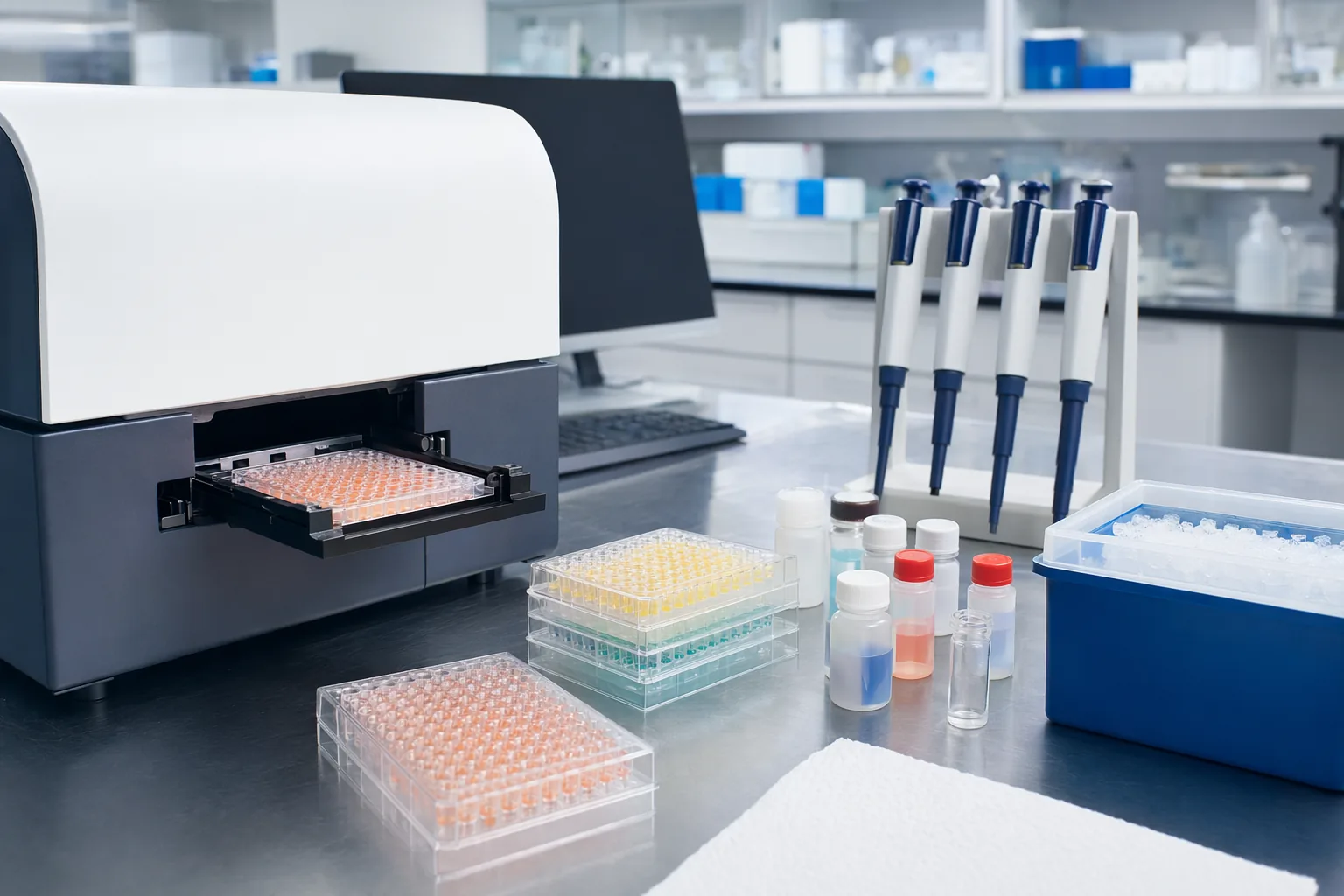
Antibody producers, ELISA kit manufacturers and reagent distributors buy horseradish peroxidase (HRP) for one job: to label a detection antibody or antigen so that every kit lot gives the same signal. The cost of a poor lot is not the enzyme price. It is a failed conjugation run, a kit lot that drifts at release, or a customer complaint after shipping.
This page sets out what to specify when you buy HRP for conjugation in volume, how to move from sample to production lots, and what to send us for a quote. To request a quote, use the inquiry form on our home page or email hello@mail.enzymelinked.com with the product, quantity and destination country.
Who buys HRP for ELISA, and why the grade matters
Three kinds of business buy HRP for ELISA work. Antibody producers conjugate HRP to their own primary or secondary antibodies and sell HRP-conjugated antibodies. ELISA kit manufacturers build the conjugate into a kit with plates, standards and substrate. Distributors and resellers supply HRP to laboratories and smaller kit makers in their region.
All three need the same thing from the enzyme: a grade that conjugates cleanly, gives low background in the finished assay and behaves the same way from one lot to the next. A catalog description does not show that. Your own conjugation and assay trial does, which is why the buying process below starts with a sample run in your format.
Our assay-grade HRP is specified at 200–400 U/mg and is supplied as lyophilized powder or solution.
What to put in your purchase specification
Write the specification before you compare quotes, so every supplier answers the same questions.
Activity: the value and the method behind it (substrate, pH, temperature, unit definition). Activity figures measured by different methods cannot be compared directly.
Form and handling: lyophilized powder or solution, storage condition and shelf life. Our HRP has a 12-month shelf life sealed at -20°C or 2–8°C.
Fitness for conjugation: confirm the grade is intended for antibody labeling and ask about any additives that could interfere with your coupling chemistry.
Documents: request COA, TDS, SDS, and lot-retention policy. Agree in writing how you will be told about process or source changes.
Pack size: match it to your conjugation batch so that opened material is used quickly. We supply 1 g to 1 kg, with custom packaging on request.
From sample to production lots
Run the sample in the format you will sell: your plates, coating and blocking buffers, sample matrix, substrate and reader. A buffer-only trial hides the problems that show up later in real samples.
If you are changing supplier, run the new lot side by side with your current one under the same conjugation ratio and substrate timing, and compare signal-to-background, low-positive recovery, blank response and precision across plates.
After approval, ask for production material from the same manufacturing route as the sample.
Shipping, storage and receiving checks
HRP is shipped either as lyophilized powder or as a solution; the shipping method is chosen with you per order, together with the packaging. On receipt, check the seal, the label and lot number against the COA, and move the material into the storage condition on the TDS straight away.
For kit makers and resellers who split material into smaller units, plan the split before the order so that pack sizes fit and repeated opening of one container is avoided. Keep a retained sample of each incoming lot so that any later complaint can be traced back.
Cost-in-use: compare what a passed kit lot costs
The price per gram is only one line of the calculation. What matters to a kit business is the cost of each kit lot that passes release.
Include the enzyme quantity per conjugation run, conjugation yield, working dilution, repeat runs, lots rejected at QC, stability failures and freight. A grade with a higher unit price can be the cheaper choice if it gives lower background, fewer repeats or more consistent lots.
Prices, lead times and freight are quoted per order. Our minimum order is 1 g for research quantities and 100 g for bulk.
HRP or alkaline phosphatase?
Many kit makers run both enzymes in their range. HRP and alkaline phosphatase use different substrates, buffers and detection windows, so a kit cannot switch from one to the other without re-optimizing the conjugate dilution, incubation, substrate and release limits.
If you are deciding which enzyme to build a new kit on, see our guide to alkaline phosphatase for ELISA kit production and our overview of ELISA enzyme supply for kit manufacturers, or ask us to quote both so you can trial them side by side.
What to send with a quote request
Product: HRP, the grade and the form (powder or solution).
Quantity: the amount per order and the expected annual volume, plus the pack size you want.
Use: antibody conjugation, kit production or resale, and the assay format.
Destination: the delivery country, so freight can be quoted.
To request a quote, use the inquiry form on our home page or email hello@mail.enzymelinked.com with the product, quantity and destination country.
Diagnostic Enzymes (ELISA & Assay Grade) for Research & Industry
Need Diagnostic Enzymes (ELISA & Assay Grade) for your lab or production process?
ISO 9001 certified · Food-grade & research-grade · Ships to 80+ countries
Frequently Asked Questions
Do you supply HRP in bulk for antibody conjugation?
Yes. Assay-grade HRP is available from 1 g to 1 kg, with custom packaging, for antibody producers and ELISA kit manufacturers. Minimum order is 1 g for research quantities and 100 g for bulk. Send the quantity and destination for a quote.
How should I choose an HRP enzyme for ELISA kit manufacturing?
Start with the final assay format, not the enzyme price alone. Define the intended use, substrate system, incubation temperature, signal window, background limit, and stability target. Then compare candidate lots using the same plates, blockers, samples, and readers used in production. Request COA, TDS, and SDS documents, verify the activity method, and calculate cost-in-use after conjugation yield and repeat-rate data are available.
What QC tests matter most for diagnostic grade enzyme selection?
Important QC checks include activity by a defined method, purity profile, protein concentration, appearance, solubility, and storage stability. For ELISA use, add functional testing: signal-to-background ratio, low-positive recovery, blank response, precision, lot-to-lot comparability, matrix interference, and substrate timing. The best specification is usually a combination of supplier release tests and your internal assay-specific acceptance criteria.
Do you work with distributors and resellers?
Yes. We quote distributors, resellers and kit manufacturers. Send the product, quantity, pack size and destination country with your inquiry.
What does cost-in-use mean when buying ELISA enzymes?
Cost-in-use measures the real cost of obtaining acceptable assay results, not just the enzyme purchase price. It includes enzyme dosage, conjugation efficiency, purification loss, working dilution, failed batches, repeat testing, stability failures, QC labor, freight, and inventory risk. A diagnostic grade enzyme with a higher unit price may be commercially better if it provides lower background, longer stability, or more consistent lot performance.
Request a quote for HRP
Send the grade, quantity, pack size and destination country. Turn This Guide Into a Supplier Brief Request HRP enzyme samples, and COA/TDS/SDS review for your ELISA program.
Contact Us to Contributehello@mail.enzymelinked.com