Industrial Alkaline Phosphatase Diagnostic ELISA Troubleshooting
Troubleshoot industrial alkaline phosphatase diagnostic ELISA with dosage, pH, temperature, QC, COA/TDS/SDS, and supplier checks.

A practical B2B guide for selecting, validating, and troubleshooting alkaline phosphatase diagnostic for ELISA workflows, from dosage and pH control to QC release and supplier qualification.
Where Industrial Alkaline Phosphatase Fits in ELISA
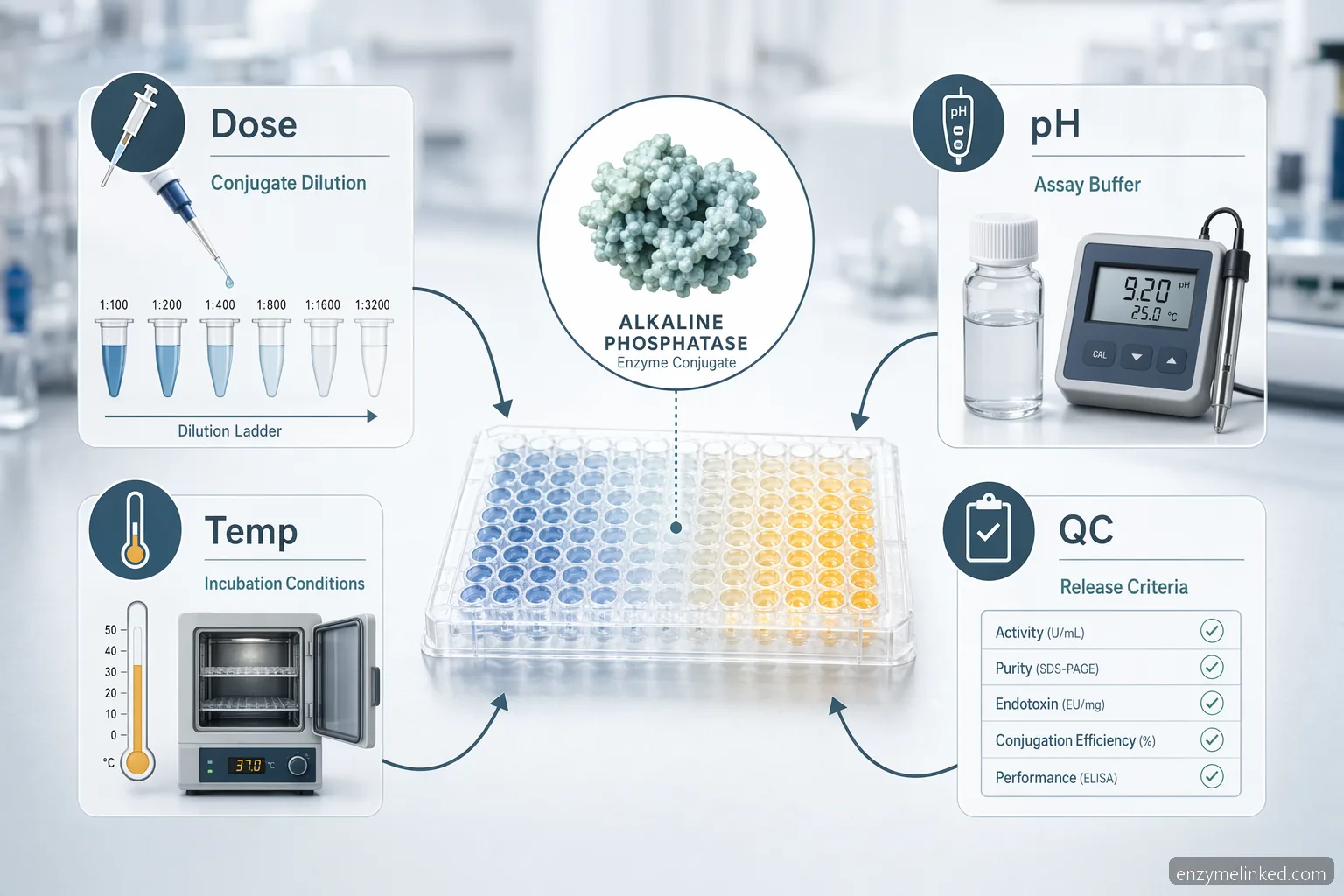
Industrial alkaline phosphatase diagnostic ELISA systems use the enzyme as a reporter label, typically conjugated to an antibody, antigen, streptavidin, or secondary detection reagent. Unlike bulk technical enzymes, diagnostic grade enzyme lots must be selected for low interfering impurities, consistent activity, stable conjugation behavior, and reproducible substrate conversion. In ELISA, alkaline phosphatase is commonly paired with chromogenic pNPP or chemiluminescent dioxetane-type substrates, with the final readout driven by enzyme loading, wash efficiency, incubation time, and matrix effects. For troubleshooting, start by defining the assay format, target sample type, required sensitivity, and plate workflow. The same enzyme lot may perform well in one immunoassay but show high background in another if blockers, preservatives, or buffers are incompatible. Buyers should request a technical data sheet, certificate of analysis, and safety data sheet before pilot work.
Best fit: ELISA, diagnostics, and immunoassay detection reagents • Key risk: lot-to-lot variability in activity or background • Primary documents: COA, TDS, SDS, and stability data
Dosage and Conjugate Dilution Troubleshooting
For alkaline phosphatase diagnostic for ELISA, dosage is usually optimized as conjugate concentration rather than free enzyme addition. A common screening range is 0.05 to 2.0 micrograms per mL of enzyme conjugate, or serial dilutions such as 1:1,000 to 1:50,000 depending on conjugation ratio, antigen abundance, and substrate sensitivity. High dosage may increase positive signal but can also raise blank absorbance, compress the dynamic range, and increase cost-in-use. Low dosage may improve background yet reduce sensitivity and precision near the cutoff. Run a checkerboard titration with capture reagent, detector reagent, and enzyme conjugate, then compare signal-to-background, coefficient of variation, and linearity across expected sample concentrations. For industrial alkaline phosphatase diagnostic immunoassay development, confirm the chosen dosage using at least one pilot lot and one production-relevant sample matrix before locking the specification.
Initial conjugate screen: 0.05-2.0 micrograms/mL • Typical dilution screen: 1:1,000-1:50,000 • Decision metrics: S/B ratio, CV, linearity, and cutoff precision
pH, Buffer, and Substrate Conditions
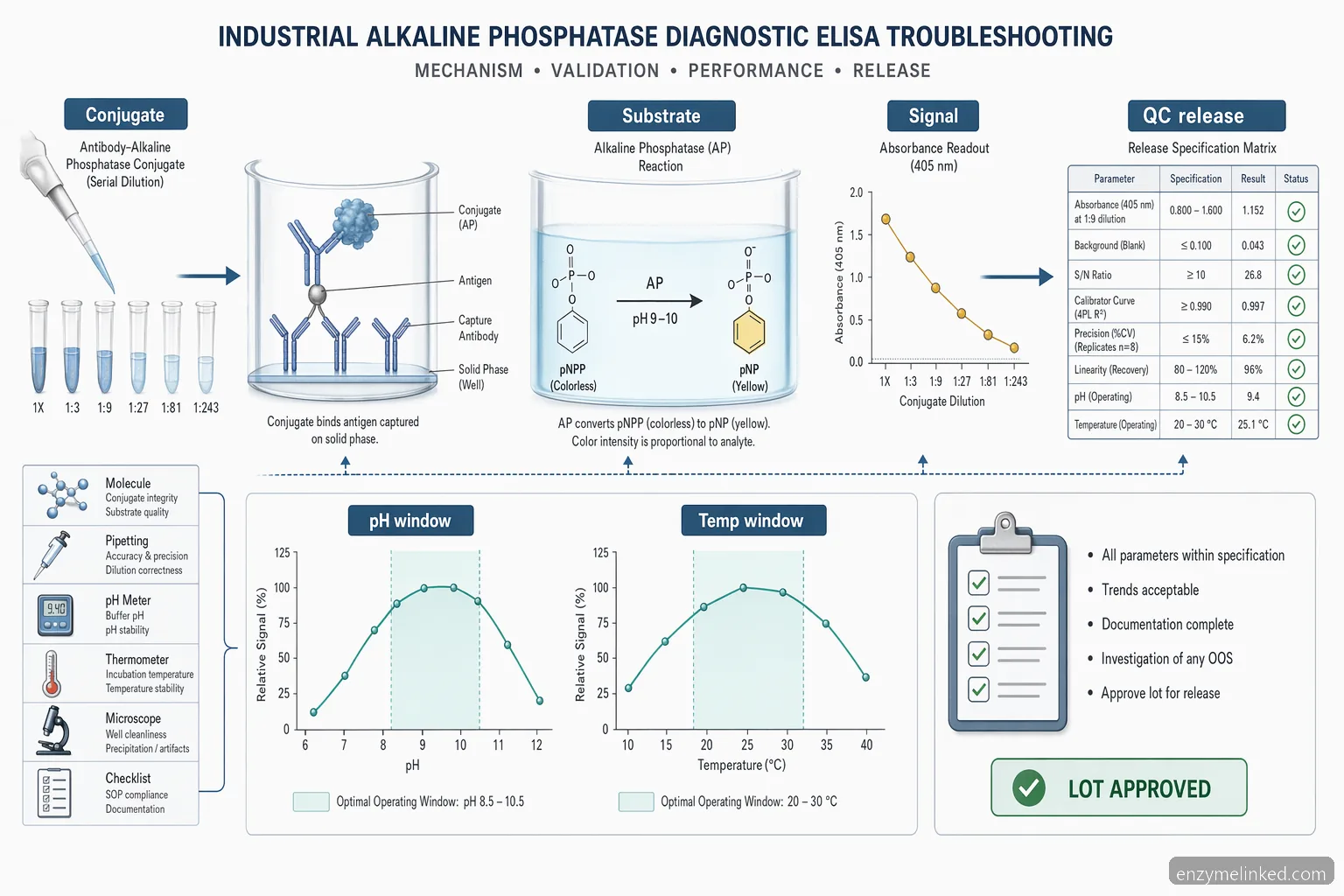
Alkaline phosphatase is most productive in alkaline substrate conditions, often around pH 9.5 to 10.5 for pNPP-based detection, while conjugate storage buffers are commonly closer to neutral pH, such as pH 7.2 to 8.2, to protect antibody structure. If an alkaline phosphatase diagnostic for immunoassay shows weak signal, verify substrate buffer pH, expiration, plate wash carryover, and inhibitor contamination before changing enzyme supplier. Phosphate can interfere with some phosphatase workflows, so buffer selection should be confirmed against the supplier TDS. Magnesium and zinc ions may support activity for many alkaline phosphatase preparations, but concentrations should be validated because excessive salts can affect antibody binding or background. Avoid assuming that a generic laboratory recipe will transfer to industrial diagnostics. A robust ELISA method should specify buffer composition, pH tolerance, substrate incubation time, and acceptable blank limits.
Common substrate pH range: 9.5-10.5 • Common conjugate storage pH: 7.2-8.2 • Confirm phosphate, chelator, preservative, and salt compatibility
Temperature, Incubation, and Stability Control
Temperature drift is a frequent cause of inconsistent industrial alkaline phosphatase diagnostic diagnostics performance. Many ELISA incubations are run at 20 to 25 degrees C for room-temperature workflows or at 37 degrees C when the method is designed for accelerated binding or substrate turnover. The selected condition must be controlled because alkaline phosphatase activity and antibody binding can both change with temperature. During troubleshooting, compare plate edge effects, incubator uniformity, reagent equilibration time, and substrate exposure time. Enzyme conjugates should normally be protected from repeated freeze-thaw cycles unless the supplier has validated that handling route. For bulk procurement, ask for recommended storage temperature, in-use stability, shipping conditions, and real-time or accelerated stability summaries. Pilot validation should include aged material, fresh material, and at least one stressed condition to estimate operational robustness before commercial release.
Common ELISA operating temperatures: 20-25 degrees C or 37 degrees C • Track reagent equilibration and plate edge effects • Validate freeze-thaw, in-use, and shipping stability
Supplier Qualification and Cost-in-Use
An alkaline phosphatase diagnostic supplier for diagnostics should be evaluated on technical fit, documentation quality, lot consistency, and responsiveness during method transfer. Request a COA showing activity method, purity or protein profile where available, appearance, storage condition, and lot number. The TDS should describe recommended handling, buffer compatibility, and assay-relevant limitations, while the SDS supports internal safety review. Do not qualify material based only on catalog activity units; compare functional titer in your ELISA, background, stability, and failure rate. Cost-in-use may favor a higher-priced diagnostic grade enzyme if it enables greater dilution, fewer repeats, longer shelf life, or tighter QC release. Before approval, run pilot validation with production-like plates, operators, wash settings, and sample matrices. Establish incoming QC criteria and a change-notification expectation for critical raw material control.
Qualify with production-relevant pilot batches • Compare functional titer instead of price per unit only • Define incoming QC and lot-change review requirements
Technical Buying Checklist
Buyer Questions
First confirm wash efficiency, blocker compatibility, substrate incubation time, and conjugate dilution. Excess enzyme conjugate is a common cause, so run a dilution series and compare blank absorbance with positive control signal. Also check substrate pH, contaminated wash buffer, plate drying, and matrix interference. If background remains high across conditions, review the enzyme COA and compare against a qualified reference lot.
The substrate step is typically alkaline, often around pH 9.5 to 10.5 for pNPP detection, but the conjugate may be stored closer to pH 7.2 to 8.2 to protect the antibody or binding partner. Do not use a single pH rule for every reagent. Confirm buffer compatibility, preservative effects, and substrate instructions in the supplier TDS during pilot validation.
Compare suppliers using functional ELISA performance, not only stated activity units. Review COA, TDS, SDS, lot traceability, storage guidance, and available stability data. Then test candidate lots in your assay with production-like plates, wash settings, sample matrices, and operators. Useful decision points include signal-to-background, CV, linearity, shelf-life behavior, dilution factor, support responsiveness, and change-notification practices.
Catalog activity is often measured in a defined biochemical assay that may not reflect your conjugated immunoassay format. Poor ELISA performance can result from conjugation ratio, interfering stabilizers, buffer mismatch, substrate conditions, antibody damage, matrix effects, or elevated nonspecific binding. Run side-by-side testing against a reference lot and evaluate functional titer, background, and stability before rejecting or approving the material.
Related Search Themes
industrial alkaline phosphatase diagnostic immunoassay, industrial alkaline phosphatase diagnostic diagnostics, alkaline phosphatase diagnostic supplier for elisa, alkaline phosphatase diagnostic for elisa, alkaline phosphatase diagnostic supplier for immunoassay, alkaline phosphatase diagnostic supplier for diagnostics
Diagnostic Enzymes (ELISA & Assay Grade) for Research & Industry
Need Diagnostic Enzymes (ELISA & Assay Grade) for your lab or production process?
ISO 9001 certified · Food-grade & research-grade · Ships to 80+ countries
Frequently Asked Questions
How do I reduce high background in alkaline phosphatase diagnostic ELISA?
First confirm wash efficiency, blocker compatibility, substrate incubation time, and conjugate dilution. Excess enzyme conjugate is a common cause, so run a dilution series and compare blank absorbance with positive control signal. Also check substrate pH, contaminated wash buffer, plate drying, and matrix interference. If background remains high across conditions, review the enzyme COA and compare against a qualified reference lot.
What pH should I use for alkaline phosphatase diagnostic for ELISA?
The substrate step is typically alkaline, often around pH 9.5 to 10.5 for pNPP detection, but the conjugate may be stored closer to pH 7.2 to 8.2 to protect the antibody or binding partner. Do not use a single pH rule for every reagent. Confirm buffer compatibility, preservative effects, and substrate instructions in the supplier TDS during pilot validation.
How should I compare alkaline phosphatase diagnostic suppliers for immunoassay production?
Compare suppliers using functional ELISA performance, not only stated activity units. Review COA, TDS, SDS, lot traceability, storage guidance, and available stability data. Then test candidate lots in your assay with production-like plates, wash settings, sample matrices, and operators. Useful decision points include signal-to-background, CV, linearity, shelf-life behavior, dilution factor, support responsiveness, and change-notification practices.
Why does a lot with high activity perform poorly in my ELISA?
Catalog activity is often measured in a defined biochemical assay that may not reflect your conjugated immunoassay format. Poor ELISA performance can result from conjugation ratio, interfering stabilizers, buffer mismatch, substrate conditions, antibody damage, matrix effects, or elevated nonspecific binding. Run side-by-side testing against a reference lot and evaluate functional titer, background, and stability before rejecting or approving the material.
Ready to source?
Turn This Guide Into a Supplier Brief Request diagnostic enzyme specifications, samples, and pilot validation support for your ELISA workflow.
Contact Us to Contribute