HRP Enzyme Supplier for ELISA: Process Guide
Source diagnostic-grade HRP for ELISA with specs, pH and temperature guidance, QC checks, COA/TDS/SDS review, pilot validation, and cost-in-use tips.
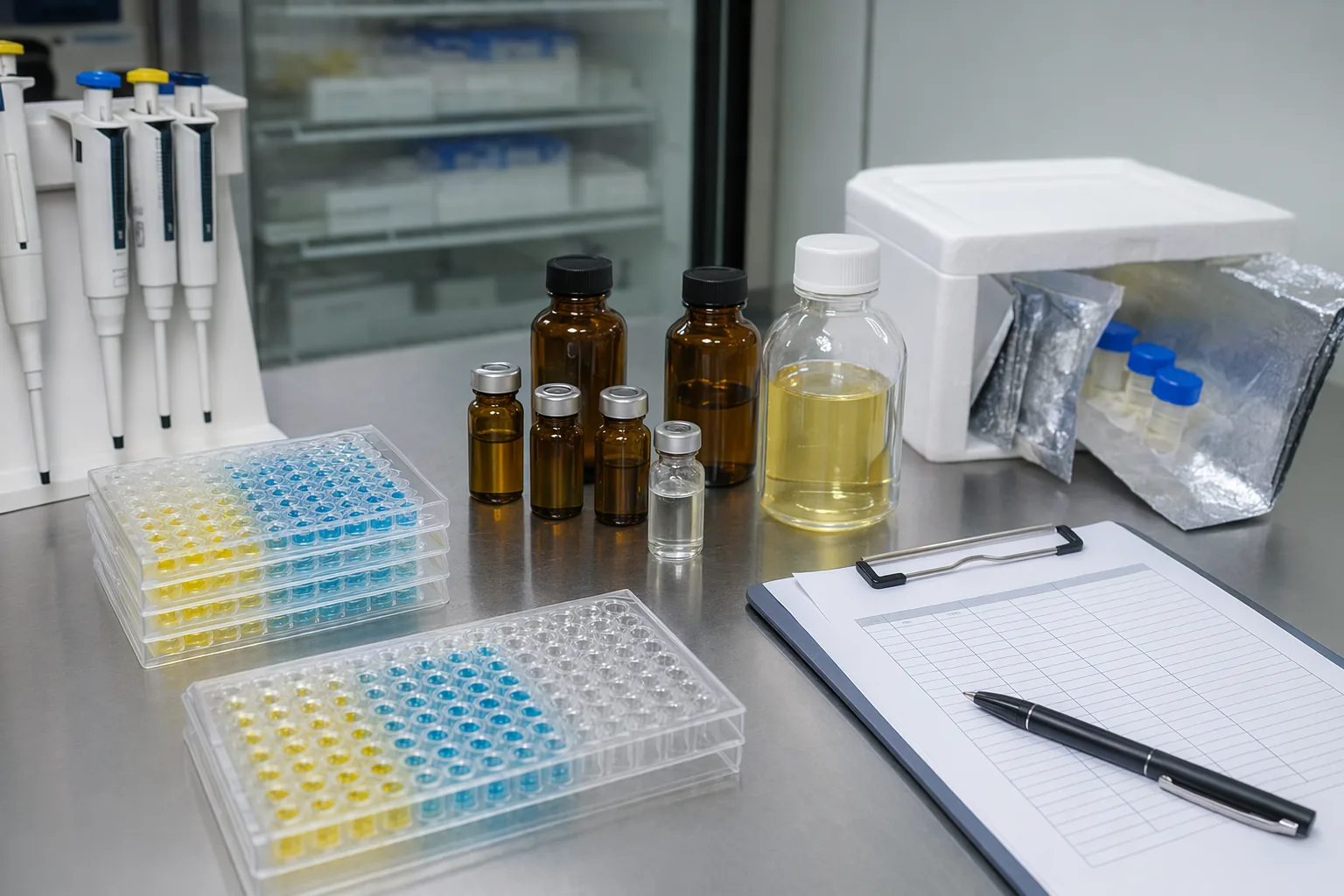
A practical sourcing and validation guide for B2B buyers specifying horseradish peroxidase and related ELISA enzymes for diagnostics and immunoassay production.
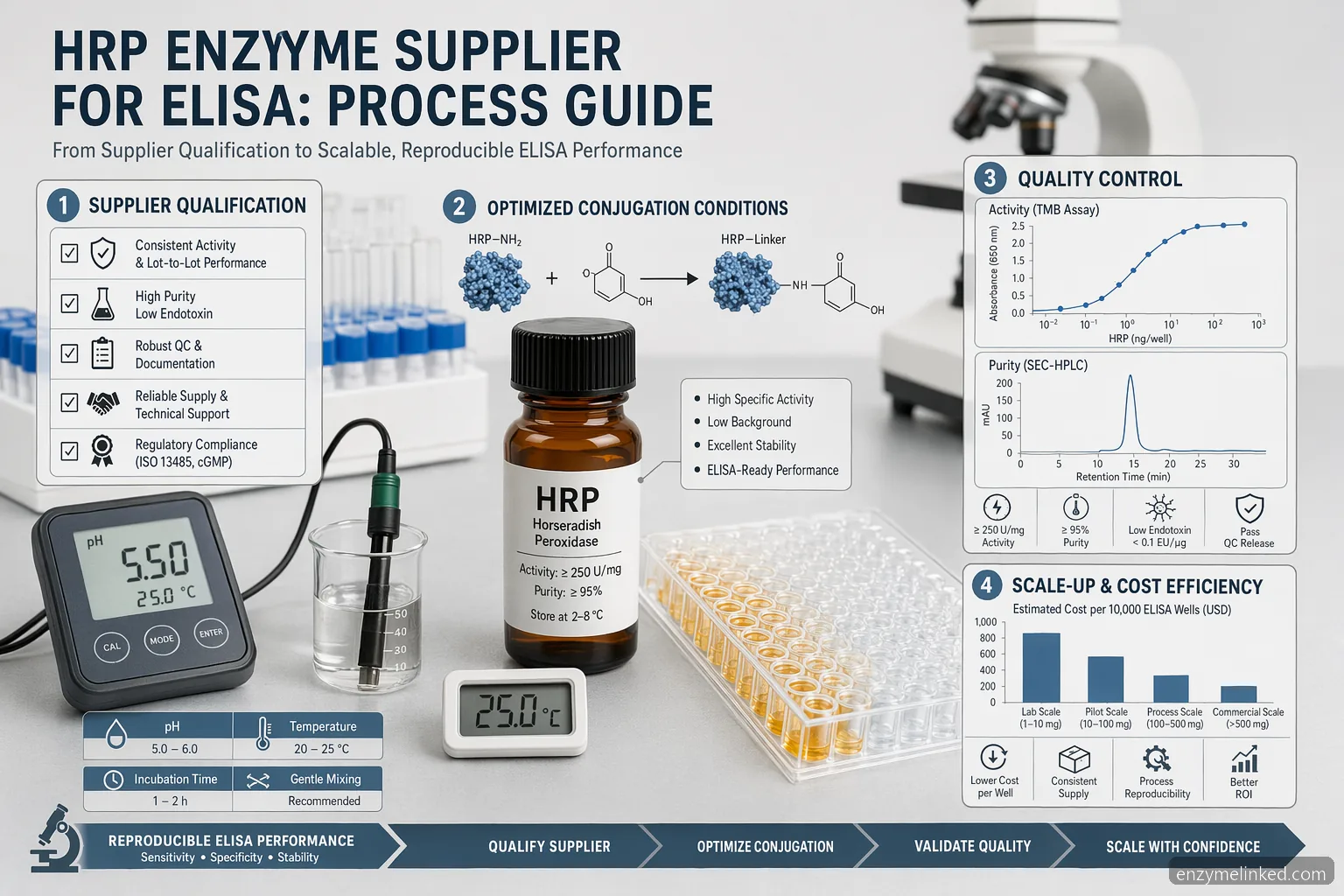
Selecting HRP for ELISA Manufacturing
For ELISA kit manufacturers, contract assay developers, and diagnostic reagent producers, choosing an HRP enzyme supplier for ELISA is a process decision, not a catalog purchase. Horseradish peroxidase is typically selected for strong chromogenic, chemiluminescent, or fluorogenic signal generation, but commercial suitability depends on lot consistency, conjugation behavior, background control, and documented quality. A diagnostic grade enzyme should be reviewed against the finished assay format: direct, indirect, sandwich, or competitive ELISA. Buyers should request representative samples and compare them against an internal reference enzyme using the same antibody, linker chemistry, blocking system, substrate, and plate type. For industrial HRP enzyme ELISA production, small differences in purity, stabilizers, or glycosylation can affect conjugate recovery and noise. The right supplier supports technical review, clear documentation, and predictable replenishment for scale-up.
Match HRP grade to the intended immunoassay format. • Confirm activity method and units are clearly defined. • Evaluate signal, background, and conjugate yield together. • Avoid switching lots without bridging data.
Process Conditions for HRP Conjugation and Assay Use
HRP enzyme for ELISA is commonly handled in buffered aqueous systems, but the best conditions depend on the conjugation route and substrate chemistry. Many antibody-HRP conjugations are developed around pH 6.5 to 8.0, while assay incubation buffers often operate near pH 7.2 to 7.6. Coating and blocking steps may use broader ranges, typically pH 7.0 to 9.6, depending on antigen stability and plate binding. Development with TMB is frequently run at room temperature, about 20 to 25 °C, with stop time controlled by absorbance targets. HRP stock solutions should be protected from microbial contamination, repeated freeze-thaw cycles, excess peroxide, and high heat. During pilot validation, test multiple enzyme-to-antibody ratios, working conjugate dilutions, and substrate development windows. A practical dosage band is determined by the response curve, not by enzyme mass alone.
Typical assay buffer pH: 7.2 to 7.6. • Common TMB development temperature: 20 to 25 °C. • Screen conjugate dilution, incubation time, and stop time. • Track peroxide exposure and freeze-thaw history.
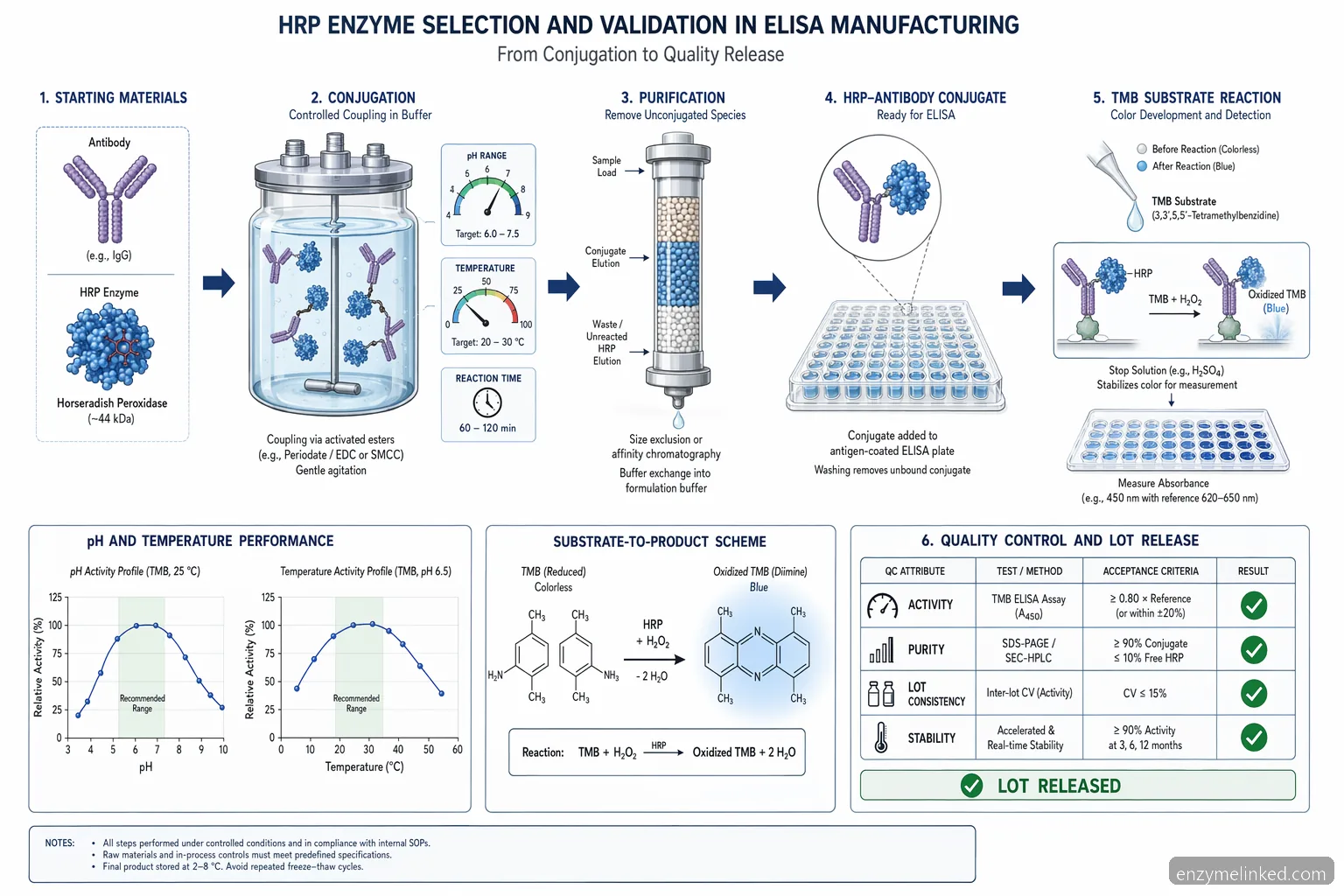
Quality Checks for Diagnostic-Grade HRP
An HRP enzyme supplier for diagnostics should provide documentation that enables incoming quality control and risk assessment. The certificate of analysis should state activity, protein concentration or purity where applicable, appearance, storage recommendation, lot number, manufacturing or retest date, and test method references. A technical data sheet should explain recommended handling, buffer compatibility, stabilizer information where disclosed, and assay-use considerations. The safety data sheet supports warehouse, laboratory, and disposal procedures. Incoming QC commonly includes identity confirmation, activity verification versus an internal control, absorbance ratio review when relevant, protein concentration, bioburden or microbial limits if required by the buyer, and a functional ELISA comparison. For regulated diagnostic workflows, change notification, lot traceability, and retained sample availability can be as important as activity value. Acceptance criteria should be written before purchase orders are scaled.
Review COA, TDS, and SDS before approval. • Run incoming activity and functional ELISA checks. • Define alert and reject limits in advance. • Confirm lot traceability and change notification practices.
Supplier Qualification for Immunoassay Programs
When evaluating an HRP enzyme supplier for immunoassay production, procurement, R&D, quality, and manufacturing teams should use a shared qualification checklist. Start with sample testing, then move to pilot lots, documented performance review, and commercial supply planning. Ask how activity is measured, how lots are blended or released, what retest intervals are used, and whether the supplier can support forecasted volume. For an ELISA enzymes supplier for immunoassay, the strongest evidence is reproducible performance in the buyer’s own assay system. A supplier questionnaire can cover site controls, allergen or animal-origin statements if relevant, contamination prevention, packaging sizes, temperature controls during shipment, and deviation handling. Avoid assuming that a general laboratory grade is suitable for diagnostic manufacturing. Qualification should also consider response time, technical competence, lead times, minimum order quantities, and the ability to reserve or repeat acceptable lots.
Use samples, pilot lots, and commercial lots as separate gates. • Assess technical support as well as price. • Verify pack sizes, lead times, and cold-chain needs. • Document supplier approval decisions.
Cost-in-Use and Scale-Up Economics
The lowest unit price does not always identify the best HRP enzyme supplier for ELISA. Cost-in-use should include conjugation efficiency, working dilution, calibration curve shape, substrate consumption, invalid run frequency, labor, rework, and shelf-life stability. A more consistent enzyme may reduce lot bridging time and finished-kit rejection, even if the purchase price is higher. During scale-up, compare at least three pilot batches using production-like equipment, fill volumes, buffers, closures, and storage conditions. Stress studies at 2 to 8 °C, room temperature, and elevated temperatures such as 37 °C can help estimate robustness, though real-time stability remains essential. Procurement should also evaluate freight conditions, packaging loss, inventory holding risk, and retest dating. For buyers seeking an ELISA enzymes supplier for ELISA production, commercial value is measured by released kits per enzyme lot, not simply enzyme units purchased.
Calculate cost per valid assay or released kit. • Include rejected batches and bridging studies in cost models. • Run accelerated and real-time stability studies. • Assess packaging and shipment losses.
HRP Compared with Alkaline Phosphatase Options
HRP and alkaline phosphatase are both established ELISA enzymes, and the best choice depends on assay design. HRP is often favored where rapid color development, high sensitivity, and common TMB workflows are desired. Alkaline phosphatase diagnostic systems can be useful where longer signal development or specific substrate compatibility is preferred. Buyers should avoid making a platform decision from enzyme activity numbers alone because substrates, blockers, matrices, incubation times, and reader settings change the final performance. If your pipeline includes multiple formats, qualify both HRP and alkaline phosphatase with the same governance process. An ELISA enzymes supplier for diagnostics should be able to discuss grade selection, documentation, storage, and pilot validation without overstating clinical performance. Final assay claims and acceptance limits must be established by the diagnostic manufacturer under its own quality system and intended-use requirements.
Select HRP for fast, common TMB-based workflows. • Consider alkaline phosphatase when assay kinetics fit the design. • Compare enzymes in the actual plate, buffer, and substrate system. • Do not translate raw activity directly into diagnostic performance.
Technical Buying Checklist
Buyer Questions
Ask for the COA, TDS, SDS, activity method, storage recommendation, lot size, retest date, sample availability, and change notification policy. Also request enough material for a functional comparison in your ELISA format. The supplier should explain handling limits, packaging options, lead times, and whether future lots can be bridged or reserved for production continuity.
Qualify the supplier through staged testing: bench samples, pilot conjugation, pilot ELISA batches, stability assessment, and incoming QC review. Include procurement and quality teams early so documentation, traceability, change control, and supply capacity are assessed alongside assay performance. The final approval should be based on your validated acceptance criteria, not on enzyme activity alone.
Many HRP-based ELISA workflows use incubation buffers near pH 7.2 to 7.6 and color development at about 20 to 25 °C. Conjugation screening often starts around pH 6.5 to 8.0, depending on chemistry and antibody stability. These ranges are starting points; each manufacturer should optimize against the substrate, matrix, blocker, and required shelf life.
Yes, if the supplier can provide suitable grades, stable lot-to-lot performance, documentation, and technical support for each program. An ELISA enzymes supplier for immunoassay R&D may also be an ELISA enzymes supplier for diagnostics, but diagnostic manufacturing usually requires tighter supplier controls, defined incoming QC, change notification, and validated pilot batches before commercial use.
ELISA is an enzyme-linked immunosorbent assay that uses enzymes such as HRP or alkaline phosphatase to generate measurable signal after antigen-antibody binding. It is different from radioimmunoassay or other radio-diagnostic methods, which use radioactive labels. When comparing methods, industrial buyers should focus on assay format, detection chemistry, safety handling, documentation, throughput, and validation requirements.
Diagnostic Enzymes (ELISA & Assay Grade) for Research & Industry
Need Diagnostic Enzymes (ELISA & Assay Grade) for your lab or production process?
ISO 9001 certified · Food-grade & research-grade · Ships to 80+ countries
Frequently Asked Questions
What should I ask an HRP enzyme supplier for ELISA before ordering?
Ask for the COA, TDS, SDS, activity method, storage recommendation, lot size, retest date, sample availability, and change notification policy. Also request enough material for a functional comparison in your ELISA format. The supplier should explain handling limits, packaging options, lead times, and whether future lots can be bridged or reserved for production continuity.
How do I qualify an HRP enzyme supplier for diagnostics?
Qualify the supplier through staged testing: bench samples, pilot conjugation, pilot ELISA batches, stability assessment, and incoming QC review. Include procurement and quality teams early so documentation, traceability, change control, and supply capacity are assessed alongside assay performance. The final approval should be based on your validated acceptance criteria, not on enzyme activity alone.
What pH and temperature ranges are typical for HRP enzyme for ELISA?
Many HRP-based ELISA workflows use incubation buffers near pH 7.2 to 7.6 and color development at about 20 to 25 °C. Conjugation screening often starts around pH 6.5 to 8.0, depending on chemistry and antibody stability. These ranges are starting points; each manufacturer should optimize against the substrate, matrix, blocker, and required shelf life.
Can one ELISA enzymes supplier support both immunoassay and diagnostics programs?
Yes, if the supplier can provide suitable grades, stable lot-to-lot performance, documentation, and technical support for each program. An ELISA enzymes supplier for immunoassay R&D may also be an ELISA enzymes supplier for diagnostics, but diagnostic manufacturing usually requires tighter supplier controls, defined incoming QC, change notification, and validated pilot batches before commercial use.
Can you describe enzyme linked immunosorbent assay elisa radio-diagnostic methods?
ELISA is an enzyme-linked immunosorbent assay that uses enzymes such as HRP or alkaline phosphatase to generate measurable signal after antigen-antibody binding. It is different from radioimmunoassay or other radio-diagnostic methods, which use radioactive labels. When comparing methods, industrial buyers should focus on assay format, detection chemistry, safety handling, documentation, throughput, and validation requirements.
Ready to source?
Turn This Guide Into a Supplier Brief Request HRP enzyme samples, COA/TDS/SDS review, and pilot-scale support for your ELISA production program.
Contact Us to Contribute