Industrial HRP Enzyme ELISA Specification Checklist
Compare HRP and alkaline phosphatase for ELISA sourcing: specs, QC, COA/TDS/SDS, pilot validation, and cost-in-use checks.

A practical comparison guide for diagnostic manufacturers selecting industrial HRP enzyme ELISA materials, alkaline phosphatase options, and qualified enzyme suppliers.
How to Compare HRP and Alkaline Phosphatase for ELISA
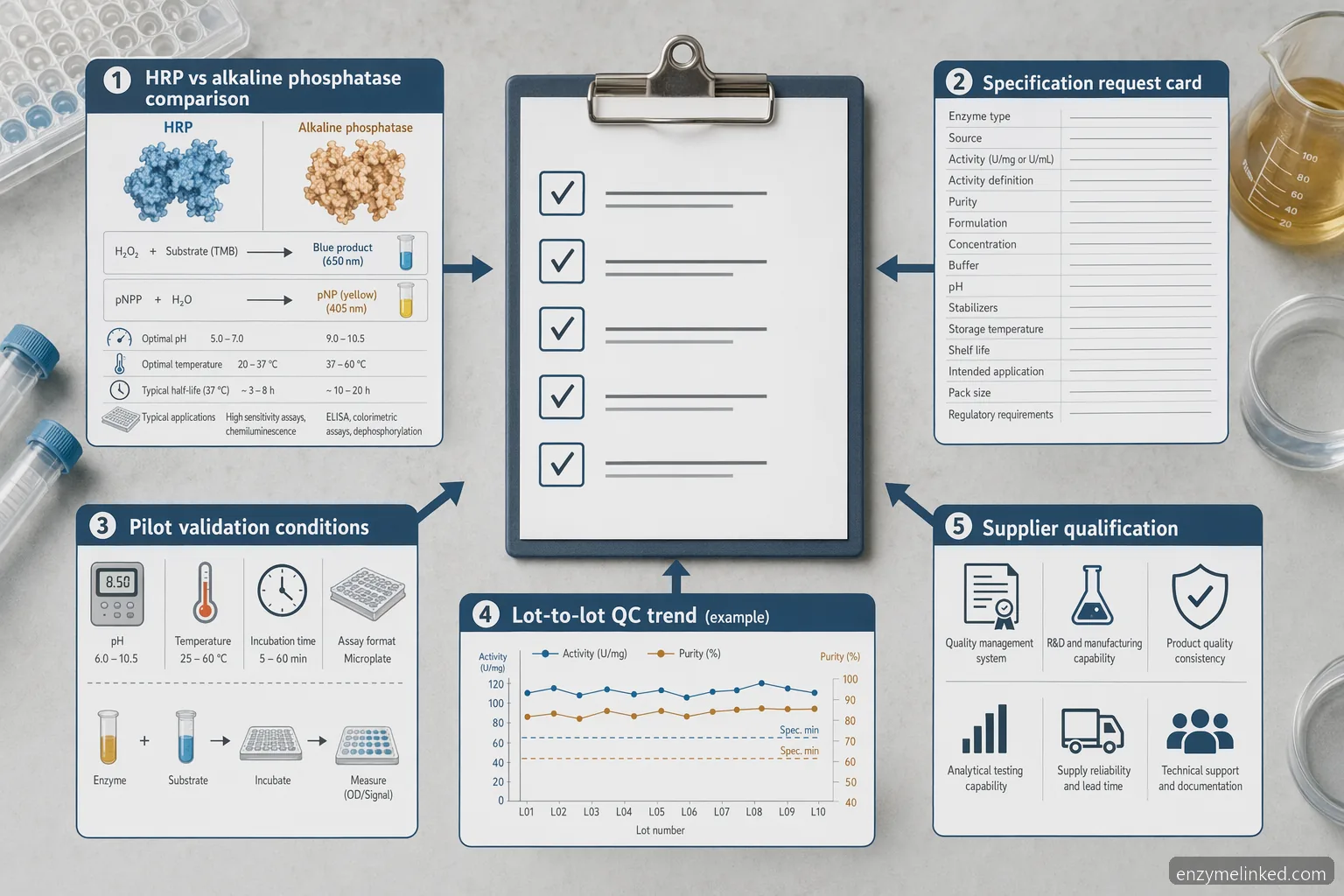
For an industrial hrp enzyme elisa program, the first decision is whether horseradish peroxidase or alkaline phosphatase is the better label for the immunoassay format. HRP is widely used where fast color development, chemiluminescent compatibility, and compact conjugates are preferred. Common HRP/TMB colorimetric systems are typically run at room temperature or 37°C, with substrate buffers often in the acidic range and assay buffers commonly near pH 7.2 to 7.6. Alkaline phosphatase diagnostic ELISA systems are often selected when longer signal development or certain high-stability formats are required, with pNPP reactions commonly operated around pH 9.5 to 10.5. The best comparison is not only signal intensity; buyers should compare background, linear range, incubation time, substrate handling, stop chemistry, and reader wavelength. In industrial ELISA enzymes immunoassay sourcing, the winning material is the one that meets sensitivity and reproducibility targets at the lowest validated cost-in-use.
HRP: fast kinetics, broad ELISA use, many substrate options. • Alkaline phosphatase: useful for alkaline substrates and extended development windows. • Compare enzymes in the final plate format, not only in bulk activity tests.
Core Specifications to Request Before Quotation
A diagnostic grade enzyme quotation should be tied to measurable specifications, not only catalog descriptions. For HRP enzyme for ELISA, request source, form, activity units, protein concentration, purity indicators, preservative system, stabilizers, buffer composition, and recommended storage. HRP preparations may include an RZ value, typically expressed as A403/A280, but this should be interpreted with functional activity and impurity data rather than as a standalone quality measure. For industrial alkaline phosphatase diagnostic ELISA use, ask for activity method, isoform or source, pH profile, metal ion requirements, and compatibility with your blocking and conjugation chemistry. Every shipment should include a lot-specific COA, and buyers should review the TDS and SDS before pilot use. If the enzyme will be conjugated to antibody, antigen, streptavidin, or polymer systems, request data on amine, thiol, carbohydrate, or activated-linker compatibility.
Require lot number, activity method, acceptance limits, and storage conditions. • Confirm whether activity is reported per mg protein, per mL, or per vial. • Check excipients for interference with conjugation or assay blockers.
Process Conditions for Pilot Validation
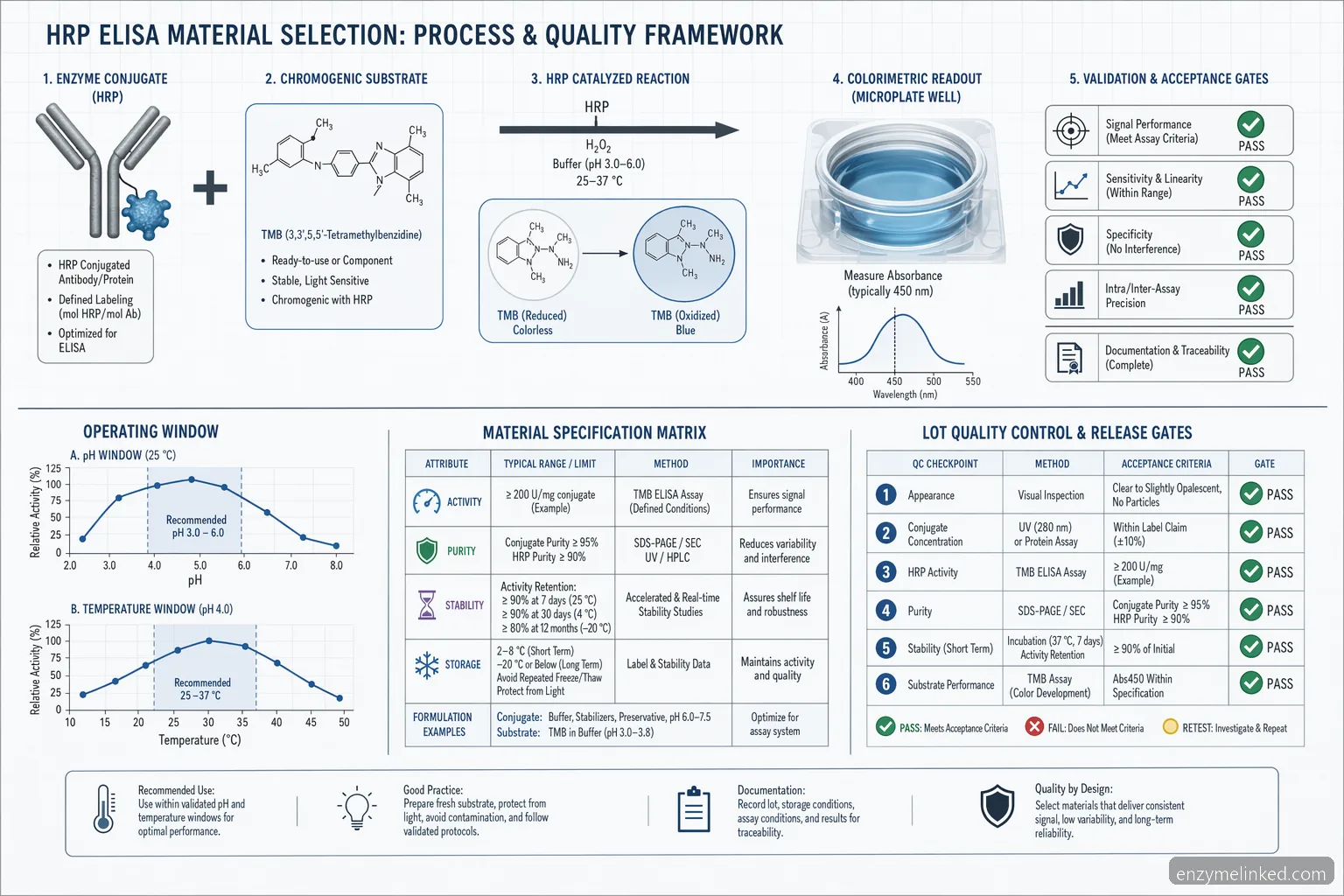
Pilot validation should reproduce intended production and user conditions. For industrial HRP enzyme diagnostics, screen enzyme or conjugate concentration across practical dosage bands such as 25 to 500 ng/mL for plate assays, or wider ranges when evaluating concentrated intermediates. Test antibody-enzyme conjugate dilutions, incubation times from 15 to 60 minutes, wash stringency, and plate blocking systems. HRP assays often operate well in neutral immunoassay buffers, while the substrate step depends on the TMB or luminol formulation. Avoid sodium azide in HRP systems because it can inhibit peroxidase activity. For alkaline phosphatase diagnostic ELISA, validate alkaline substrate buffers and confirm that phosphate, chelators, or metal ions do not suppress performance. Run comparisons at 20 to 25°C and 37°C if both conditions are possible in your workflow. The pilot should measure signal-to-background, precision, limit of detection, hook effect risk, and stability after real handling.
Screen multiple enzyme loads instead of adopting a single supplier recommendation. • Include accelerated and real-time stability pulls when timelines allow. • Measure both analytical signal and manufacturing robustness.
QC Checks That Protect Lot-to-Lot Performance
Industrial ELISA enzymes diagnostics purchasing should include incoming QC beyond visual inspection and document filing. Confirm identity, activity, protein concentration, pH, appearance, and microbial or particulate risk where relevant to your manufacturing process. Functional QC is essential: compare the new lot against an approved reference lot in the actual ELISA format using low, mid, and high controls. Track precision as intra-assay and inter-assay CV, and define lot acceptance criteria before supplier approval. For HRP enzyme supplier for ELISA qualification, request representative COA examples and ask whether methods, raw material source, stabilizers, or release specifications can change without notice. If your process uses automated dispensing, include viscosity, foaming, and filtration compatibility checks. For conjugated enzymes, evaluate free enzyme, aggregation, binding retention, and signal decay after storage. Documentation should support traceability and practical deviation investigation without relying on unverifiable marketing claims.
Use a retained internal reference lot for bridging studies. • Set pass/fail limits for signal, background, CV, and stability. • Record any supplier process or formulation change notification requirement.
Cost-in-Use and Supplier Qualification
The lowest unit price is rarely the lowest production cost. Cost-in-use for industrial hrp enzyme immunoassay manufacturing should include enzyme loading, conjugation yield, rework risk, stability losses, QC labor, substrate consumption, and failed-lot exposure. A more expensive HRP or alkaline phosphatase material may be justified if it reduces background, extends shelf life, or enables a lower working concentration. Supplier qualification should cover technical responsiveness, lot reservation options, lead time, packaging sizes, cold-chain requirements, change control communication, and availability of COA, TDS, and SDS documents before shipment. Ask for pilot quantities from the same grade intended for scale-up, then bridge at least one additional lot before locking specifications. For industrial ELISA enzymes ELISA production, maintain dual sourcing where feasible, but avoid assuming equivalence. Each alternate supplier should pass the same functional assay, stability, and manufacturing compatibility checks as the primary supplier.
Compare price per qualified plate or kit, not only price per gram or vial. • Include cold-chain, testing, failures, and shelf-life impact in the model. • Approve suppliers only after pilot validation and document review.
Technical Buying Checklist
Buyer Questions
HRP is common because it supports fast colorimetric and chemiluminescent reactions, works in many antibody conjugate formats, and can deliver strong signal at relatively low working concentrations. For industrial hrp enzyme elisa selection, buyers should still validate background, stability, substrate compatibility, and lot consistency. Performance depends on the final conjugate, buffer system, plate surface, incubation profile, and wash method, not the bulk enzyme alone.
Alkaline phosphatase should be compared when the assay benefits from alkaline substrate chemistry, longer development windows, or a different stability profile. It is especially relevant if HRP substrates create background, if assay timing is less constrained, or if the platform already uses AP-compatible reagents. The comparison should include pH, substrate cost, signal range, stop conditions, and kit shelf-life impact.
A qualified supplier should provide a lot-specific COA, current TDS, and SDS before or with shipment. The COA should state activity method, acceptance criteria, lot number, storage conditions, and key quality attributes. The TDS should explain handling, recommended use, formulation, and stability guidance. Buyers should also request change notification expectations and representative historical lot data when qualifying a strategic diagnostic enzyme source.
Calculate cost-in-use by modeling the enzyme quantity required per plate or kit, conjugation yield, dilution factor, substrate choice, QC burden, stability losses, and failure risk. A lower-priced enzyme can cost more if it requires higher loading or causes variable background. Compare suppliers using validated pilot data, not only quotation price, and include cold-chain, inventory, documentation, and requalification costs.
Related Search Themes
industrial hrp enzyme immunoassay, industrial hrp enzyme diagnostics, industrial elisa enzymes immunoassay, industrial elisa enzymes elisa, industrial elisa enzymes diagnostics, industrial alkaline phosphatase diagnostic elisa
Diagnostic Enzymes (ELISA & Assay Grade) for Research & Industry
Need Diagnostic Enzymes (ELISA & Assay Grade) for your lab or production process?
ISO 9001 certified · Food-grade & research-grade · Ships to 80+ countries
Frequently Asked Questions
What makes HRP a common choice for industrial ELISA production?
HRP is common because it supports fast colorimetric and chemiluminescent reactions, works in many antibody conjugate formats, and can deliver strong signal at relatively low working concentrations. For industrial hrp enzyme elisa selection, buyers should still validate background, stability, substrate compatibility, and lot consistency. Performance depends on the final conjugate, buffer system, plate surface, incubation profile, and wash method, not the bulk enzyme alone.
When should alkaline phosphatase be compared with HRP?
Alkaline phosphatase should be compared when the assay benefits from alkaline substrate chemistry, longer development windows, or a different stability profile. It is especially relevant if HRP substrates create background, if assay timing is less constrained, or if the platform already uses AP-compatible reagents. The comparison should include pH, substrate cost, signal range, stop conditions, and kit shelf-life impact.
Which documents should an ELISA enzyme supplier provide?
A qualified supplier should provide a lot-specific COA, current TDS, and SDS before or with shipment. The COA should state activity method, acceptance criteria, lot number, storage conditions, and key quality attributes. The TDS should explain handling, recommended use, formulation, and stability guidance. Buyers should also request change notification expectations and representative historical lot data when qualifying a strategic diagnostic enzyme source.
How should cost-in-use be calculated for ELISA enzymes?
Calculate cost-in-use by modeling the enzyme quantity required per plate or kit, conjugation yield, dilution factor, substrate choice, QC burden, stability losses, and failure risk. A lower-priced enzyme can cost more if it requires higher loading or causes variable background. Compare suppliers using validated pilot data, not only quotation price, and include cold-chain, inventory, documentation, and requalification costs.
Ready to source?
Turn This Guide Into a Supplier Brief Request ELISA enzyme sourcing support, specification review, and pilot-lot comparison for your diagnostic workflow.
Contact Us to Contribute