Industrial HRP Enzyme Diagnostics: ELISA Dosage, pH, and Temperature Control
Troubleshoot industrial HRP enzyme diagnostics for ELISA: dosage, pH, temperature, QC checks, COA/TDS/SDS, pilot validation.

A practical B2B guide for selecting and validating diagnostic grade HRP and alkaline phosphatase enzymes for ELISA and immunoassay manufacturing.
Troubleshooting HRP Enzyme Performance in ELISA Manufacturing
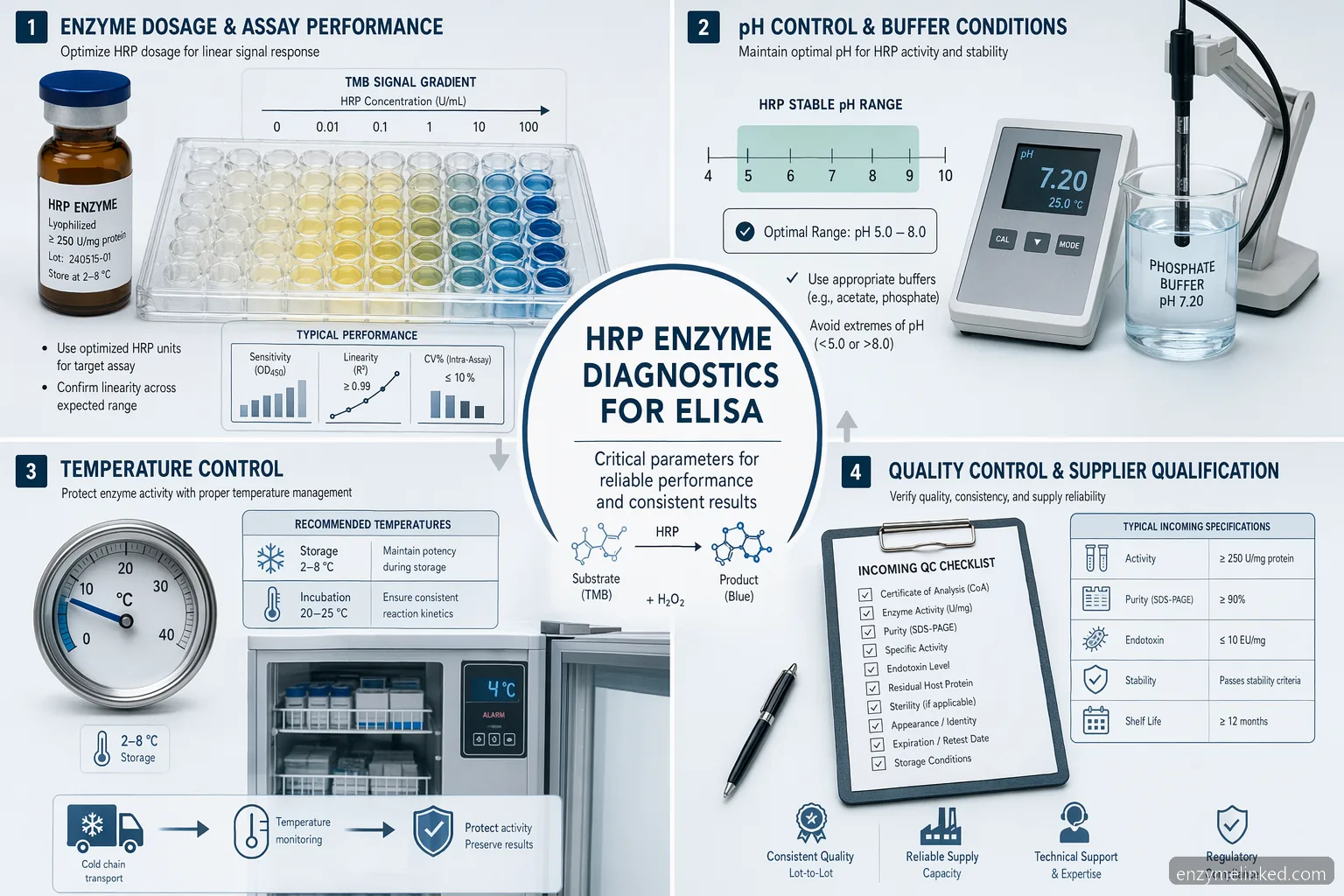
Industrial HRP enzyme diagnostics work best when troubleshooting begins with the assay system, not the enzyme label. In industrial HRP enzyme ELISA workflows, poor signal may come from low conjugate loading, inactive substrate, excessive wash stringency, oxidant exposure, or incompatible blockers. High background often indicates over-dosed HRP conjugate, inadequate washing, matrix interference, or non-specific binding from the antibody pair. For initial optimization, run a checkerboard titration using antigen or capture antibody concentration against HRP conjugate dilution. Many sandwich ELISA systems screen HRP conjugates from about 0.05 to 2.0 micrograms per mL, or approximately 1:2,000 to 1:50,000 dilution when supplied as a concentrated conjugate. Confirm linear range, blank response, limit of quantitation, and hook effect under the intended sample matrix. This is general enzyme diagnostics troubleshooting for assay developers, QC labs, and kit manufacturers rather than clinical interpretation.
Compare fresh versus stressed conjugate to identify storage-related loss. • Check substrate age, light exposure, and stop-solution consistency. • Track blank OD, positive control OD, and signal-to-background ratio.
pH, Buffer, and Temperature Ranges for Diagnostic Enzyme Stability
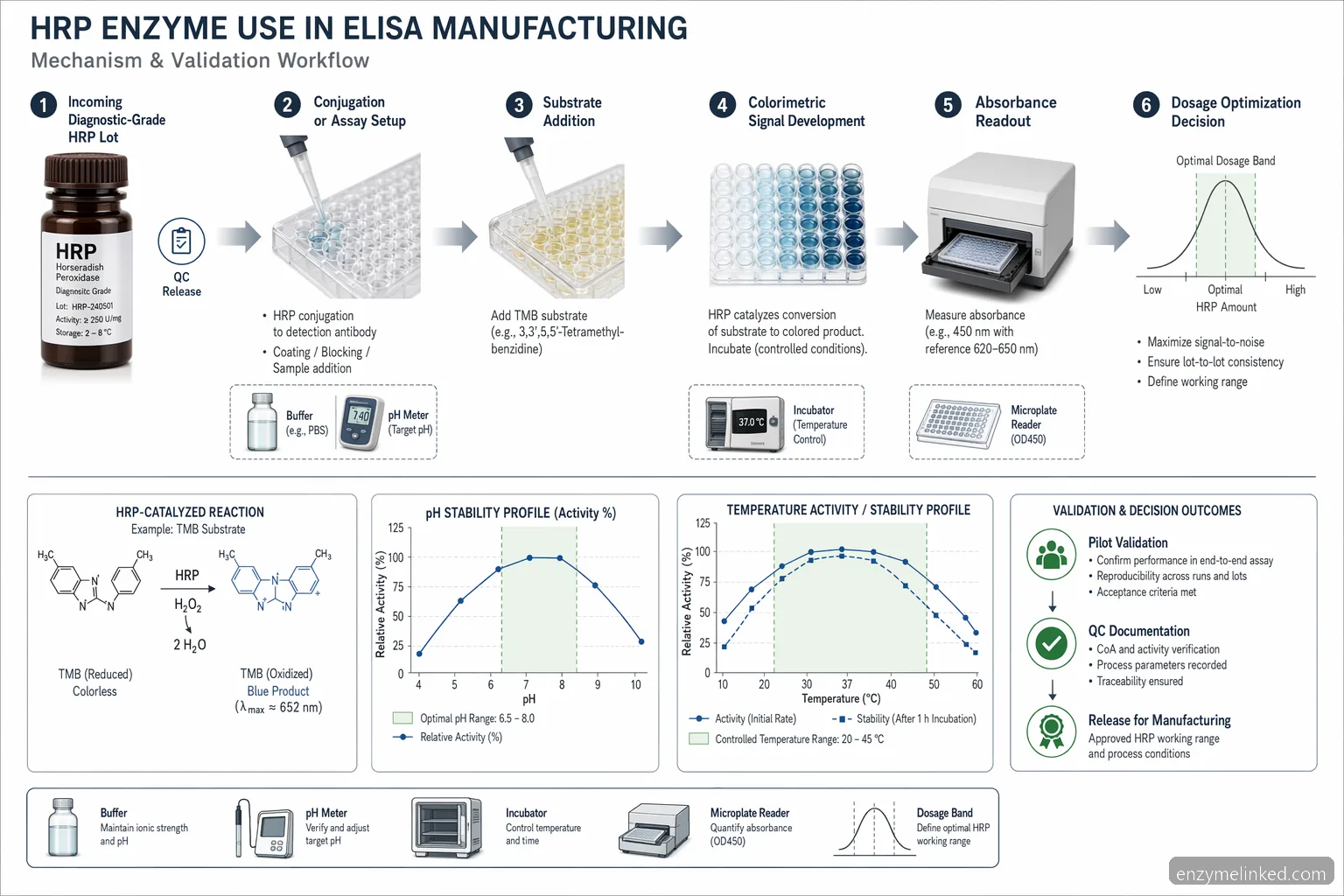
HRP and alkaline phosphatase diagnostic systems have different pH preferences, so buffer carryover must be considered during formulation. HRP conjugates are commonly stored in phosphate or buffered protein stabilizers near pH 7.0 to 7.4, often at 2 to 8 degrees C with microbial control suitable for the intended use. HRP color development with TMB is typically performed in mildly acidic substrate systems, commonly around pH 5.0 to 6.0. By contrast, industrial alkaline phosphatase diagnostic diagnostics using pNPP often require alkaline substrate conditions, commonly near pH 9.5 to 10.5. Incubation is usually validated at controlled room temperature, 20 to 25 degrees C, or at 37 degrees C when the assay design requires faster kinetics. Avoid repeated freeze-thaw cycles unless validated; if freezing is necessary, qualify cryoprotectant, container closure, and thaw time.
Validate pH after adding blockers, preservatives, and protein stabilizers. • Monitor edge effects when incubating plates at 37 degrees C. • Use temperature-mapped storage and shipping studies for released lots.
Dosage Bands, Pilot Validation, and Cost-in-Use
For industrial HRP enzyme immunoassay production, dosage should be defined as a validated operating window rather than a single number. A practical pilot plan includes three to five enzyme conjugate levels, at least two substrate incubation times, and representative negative, low-positive, mid-positive, and high-positive samples. If the conjugate is too concentrated, background may rise faster than signal; if too dilute, low-end sensitivity and reproducibility may fail. Evaluate coefficient of variation, recovery, parallelism, stability after open-vial use, and plate-to-plate uniformity. Cost-in-use should include working dilution, substrate consumption, repeat rate, release-test failures, stability claims, and logistics risk. Industrial ELISA enzymes diagnostics are often purchased on consistency and support data, not merely activity units. A higher-purity or better-stabilized diagnostic grade enzyme can reduce total cost if it improves dilution factor and lowers rejected kit lots.
Use pilot lots before locking the master formulation. • Calculate enzyme cost per finished plate or test. • Include accelerated and real-time stability checkpoints.
Incoming QC and Documentation for Supplier Qualification
Supplier qualification should connect purchasing specifications with assay performance. Request a COA for each lot showing identity, activity method, purity indicator, concentration, storage recommendation, manufacturing date or retest date, and lot traceability. The TDS should explain enzyme source, formulation, recommended handling, activity definition, and compatible buffers. The SDS should address safe handling, transport, and disposal information for the supplied material. Incoming QC may include absorbance ratio for HRP, protein concentration, activity assay, SDS-PAGE or chromatographic purity where relevant, bioburden or microbial limits when specified, and functional ELISA bridging against an approved reference lot. Avoid relying only on unit activity because different assay methods can assign different values. For regulated diagnostic manufacturing, document change notification expectations, lot reservation options, deviation handling, and retention sample policy before routine ordering.
Bridge every new lot against an internal reference standard. • Define acceptance criteria before requesting commercial scale supply. • Keep COA, TDS, SDS, and incoming QC records linked by lot number.
When to Compare HRP, Alkaline Phosphatase, and Other Enzyme Assays
HRP is widely used in ELISA because it supports fast colorimetric and chemiluminescent readouts, but it is not the only diagnostic enzyme option. Alkaline phosphatase may be preferred when longer substrate development or specific signal kinetics fit the workflow. In broader assay development, lipase enzyme assay diagnostics, metabolic enzyme tests, and other activity-based formats follow different sample preparation and calibration principles than immunoassays. Keep procurement requirements separate: an enzyme used as an ELISA label is evaluated for conjugation behavior, signal generation, and stability, while an analyte enzyme assay is evaluated for substrate turnover in the sample matrix. For industrial HRP enzyme diagnostics, final selection should be based on the intended platform, detection chemistry, sample type, reader settings, throughput, and shelf-life target. A qualified supplier should support pilot validation without making unsupported performance claims outside the tested application.
Match enzyme label to substrate chemistry and reader capability. • Do not transfer specifications between unrelated diagnostic assay types. • Confirm matrix effects with real production buffers and sample diluents.
Technical Buying Checklist
Buyer Questions
High background usually comes from excessive HRP conjugate, non-specific antibody binding, incomplete washing, contaminated substrate, or matrix interference. Start with a checkerboard dilution, verify wash volume and soak time, compare blockers, and inspect substrate blanks. Also confirm that plate incubation temperature is uniform, because edge effects can make a good formulation appear unstable.
Qualification should combine documentation and functional testing. Request COA, TDS, SDS, lot traceability, change notification practices, and storage guidance. Then bridge at least one pilot lot against your approved reference lot in the actual ELISA format. Compare signal, background, precision, dilution factor, and stability before approving routine supply or reserving production lots.
Neither is universally better. HRP is often selected for fast colorimetric or chemiluminescent formats and broad reagent availability. Alkaline phosphatase can be useful when its substrate kinetics, alkaline pH requirements, or signal development profile fit the assay. The correct choice depends on sample matrix, reader settings, shelf-life goal, background tolerance, and validated cost-in-use.
The most useful checks link enzyme characterization to finished assay performance. Use activity testing, protein concentration, purity or absorbance ratio where appropriate, visual inspection, and a functional ELISA bridge against a reference lot. Track blank OD, positive control response, calibration curve slope, precision, and recovery. Release criteria should be written before production purchasing begins.
Diagnostic Enzymes (ELISA & Assay Grade) for Research & Industry
Need Diagnostic Enzymes (ELISA & Assay Grade) for your lab or production process?
ISO 9001 certified · Food-grade & research-grade · Ships to 80+ countries
Frequently Asked Questions
What causes high background in industrial HRP enzyme ELISA workflows?
High background usually comes from excessive HRP conjugate, non-specific antibody binding, incomplete washing, contaminated substrate, or matrix interference. Start with a checkerboard dilution, verify wash volume and soak time, compare blockers, and inspect substrate blanks. Also confirm that plate incubation temperature is uniform, because edge effects can make a good formulation appear unstable.
How should a buyer qualify a diagnostic grade enzyme supplier?
Qualification should combine documentation and functional testing. Request COA, TDS, SDS, lot traceability, change notification practices, and storage guidance. Then bridge at least one pilot lot against your approved reference lot in the actual ELISA format. Compare signal, background, precision, dilution factor, and stability before approving routine supply or reserving production lots.
Is HRP or alkaline phosphatase better for diagnostic ELISA kits?
Neither is universally better. HRP is often selected for fast colorimetric or chemiluminescent formats and broad reagent availability. Alkaline phosphatase can be useful when its substrate kinetics, alkaline pH requirements, or signal development profile fit the assay. The correct choice depends on sample matrix, reader settings, shelf-life goal, background tolerance, and validated cost-in-use.
What QC checks are most useful for lot-to-lot control?
The most useful checks link enzyme characterization to finished assay performance. Use activity testing, protein concentration, purity or absorbance ratio where appropriate, visual inspection, and a functional ELISA bridge against a reference lot. Track blank OD, positive control response, calibration curve slope, precision, and recovery. Release criteria should be written before production purchasing begins.
Related: Diagnostic Enzymes for Reliable Assay Performance
Turn This Guide Into a Supplier Brief Send your ELISA conditions to EnzymeLinked for diagnostic enzyme sourcing, pilot validation support, and lot-to-lot supply planning. See our application page for Diagnostic Enzymes for Reliable Assay Performance at /applications/diagnostics-importance/ for specs, MOQ, and a free 50 g sample.
Contact Us to Contribute