Industrial ELISA Enzymes for Scalable Immunoassay Manufacturing
Select HRP and alkaline phosphatase for industrial ELISA workflows with process ranges, QC checks, pilot validation, and supplier qualification steps.
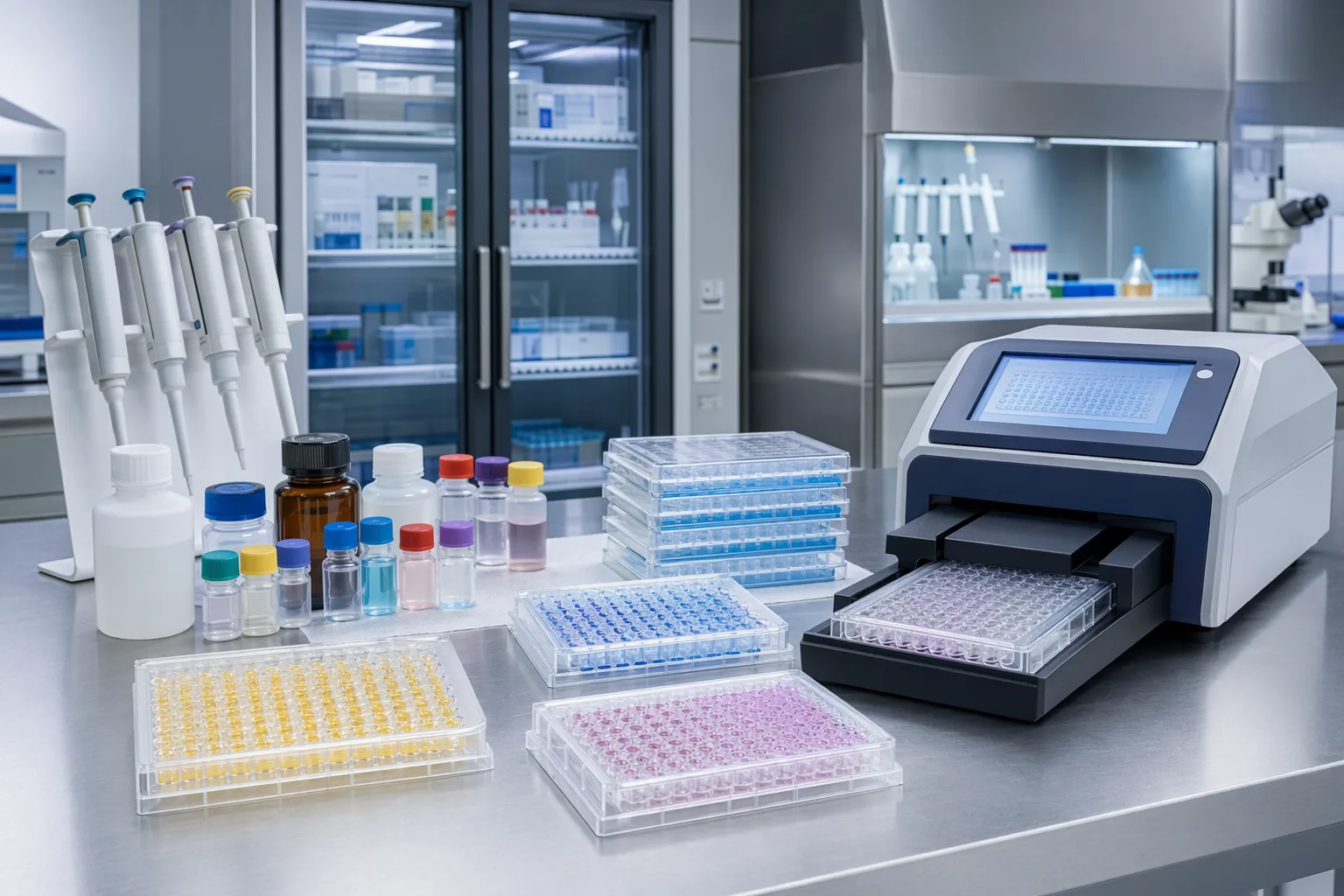
A practical B2B guide to selecting, validating, and sourcing HRP and alkaline phosphatase enzymes for ELISA kit production and diagnostic immunoassay workflows.
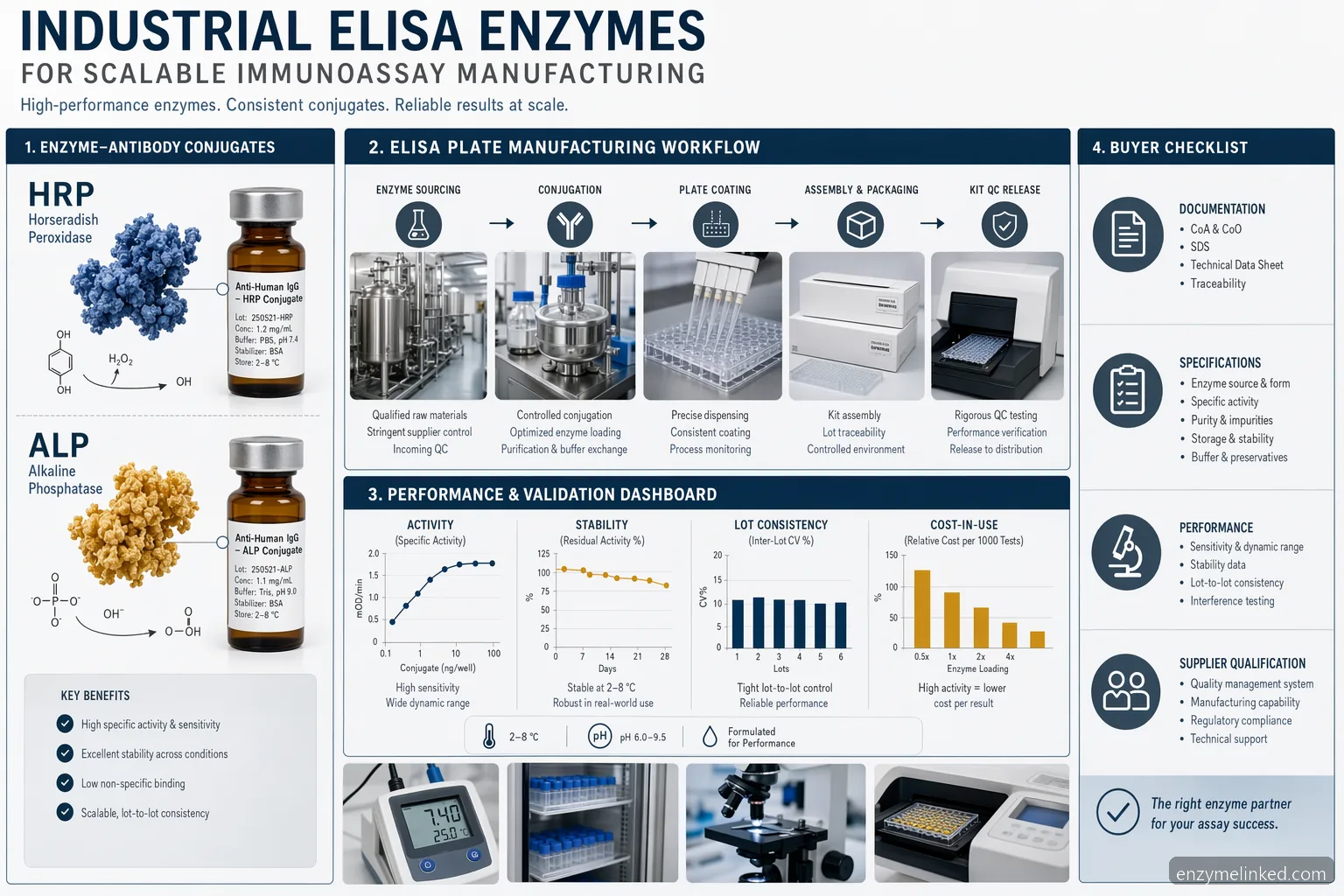
Where Industrial ELISA Enzymes Fit in Kit Manufacturing
Industrial ELISA enzymes are process-critical reagents used to convert antigen-antibody binding into a measurable signal. For most diagnostic and research immunoassay formats, the main choices are horseradish peroxidase (HRP enzyme) and alkaline phosphatase diagnostic conjugates or enzyme labels. HRP is commonly selected for fast color development and compact workflows, while alkaline phosphatase is often considered where extended signal development or specific substrate chemistry is preferred. In a B2B setting, enzyme selection should begin with the assay format, target sensitivity, sample matrix, plate chemistry, substrate, and required shelf life. The phrase industrial elisa enzymes elisa should be understood as a manufacturing decision, not only a catalog purchase. A suitable ELISA enzymes supplier for immunoassay production should support pilot validation, provide transparent specifications, and help confirm that the diagnostic grade enzyme candidate performs consistently under your real coating, blocking, washing, and detection conditions.
Common applications: ELISA, diagnostics, immunoassay kit assembly, and process-development batches. • Typical enzyme labels: HRP and alkaline phosphatase. • Primary buying criteria: performance consistency, documentation, supply continuity, and cost-in-use.
Process Conditions for HRP and Alkaline Phosphatase
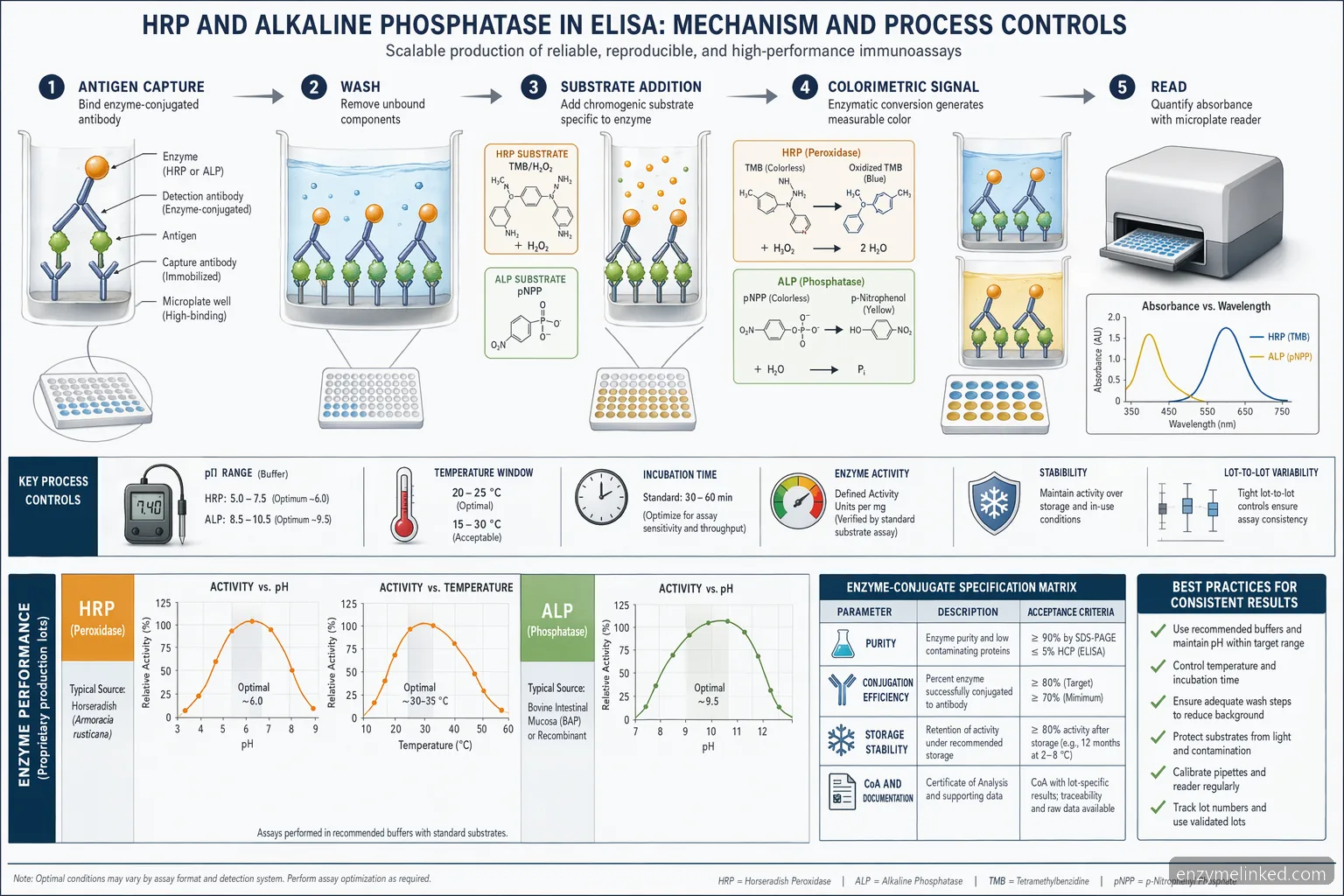
Process conditions must be confirmed experimentally because enzyme performance depends on conjugate design, substrate, buffer composition, and matrix effects. For industrial HRP enzyme ELISA workflows, coating and blocking are often run near neutral pH, while HRP conjugates typically perform well in buffered assay systems around pH 6.0–7.5. TMB substrate reactions are commonly developed at room temperature, often 20–25 °C, with controlled timing to prevent saturation. For industrial alkaline phosphatase diagnostic ELISA development, enzyme activity is commonly evaluated in alkaline buffers, frequently around pH 8.8–10.5 depending on substrate system. Incubations are usually performed at room temperature or 37 °C when validated. Starting conjugate dilution screens commonly span 1:1,000 to 1:20,000, then narrow based on signal-to-background ratio, limit of detection, and hook-effect behavior. Avoid changing pH, surfactant, preservative, or incubation time after validation unless the impact is requalified.
HRP assay pH screening: commonly pH 6.0–7.5. • Alkaline phosphatase screening: commonly pH 8.8–10.5. • Typical incubation temperatures: 20–25 °C or validated 37 °C steps. • Initial conjugate dilution screen: often 1:1,000 to 1:20,000.
Pilot Validation Before Scale-Up
Pilot validation is essential before committing to production lots of ELISA enzymes supplier for ELISA programs. Start with side-by-side testing of at least two candidate lots under the intended plate, blocker, wash buffer, substrate, and sample matrix. Evaluate standard curve shape, blank response, top signal, dynamic range, precision, and lot-to-lot comparability. Include low-positive and high-positive samples where appropriate, plus known negative or blank matrix controls. For enzymes diagnostic properties ELISA candidate screening, measure not only activity units but also functional performance after conjugation or binding to detection reagents. A high activity value does not guarantee low background or stable signal in the final kit. Pilot batches should include accelerated stability, real-time storage initiation, freeze-thaw checks if relevant, and shipping-condition simulation. Document the final process window so procurement can lock specifications with the selected supplier and reduce downstream reformulation risk.
Compare at least two lots or sources when practical. • Test in the final assay matrix, not only in generic buffer. • Track signal-to-background ratio, precision, curve fit, and stability. • Use pilot data to define purchasing specifications.
QC Checks and Documentation Buyers Should Require
A qualified ELISA enzymes supplier for diagnostics should provide documentation that supports receiving inspection, release testing, and regulatory file preparation without making unsupported claims. Request a COA for each lot, a TDS with recommended handling and assay conditions, and an SDS for safe storage and use. The COA should identify lot number, activity or functional potency method, appearance, storage condition, and relevant purity or contaminant limits when available. Buyer-side QC commonly includes activity confirmation, protein concentration, purity profile by electrophoresis or chromatography, functional ELISA performance, background response, and short-term stability. For conjugated enzymes, add conjugation ratio or functional titer where applicable. Incoming QC should also check packaging integrity, cold-chain records when specified, and date of manufacture or retest date. Clear change-notification expectations are important because buffer, stabilizer, or production-process changes can affect immunoassay performance.
Request COA, TDS, SDS, storage guidance, and lot traceability. • Confirm functional ELISA performance, not only biochemical activity. • Define acceptable ranges for background, titer, precision, and stability. • Ask suppliers how formulation or process changes are communicated.
Cost-in-Use and Supplier Qualification
For industrial ELISA enzymes diagnostics programs, the lowest price per milligram may not deliver the lowest finished-kit cost. Cost-in-use should include conjugate dilution, assay failure rate, QC workload, stability margin, customer complaint risk, and availability of technical support. A more concentrated or cleaner enzyme may be economical if it permits higher dilution, lower background, or fewer rejected batches. Supplier qualification should review manufacturing consistency, batch records available to customers, lead time, packaging sizes, storage conditions, minimum order quantities, and capacity for repeat supply. Ask for retain-sample policy, shelf-life rationale, and whether the supplier can reserve or forecast production lots for larger programs. For industrial ELISA enzymes immunoassay production, a structured qualification process reduces formulation drift and improves supply resilience. Final approval should be based on documented pilot validation, purchasing specifications, and agreed communication channels for quality or supply changes.
Calculate cost per coated plate, strip, or finished kit, not only unit price. • Include QC failures, stability losses, and dilution factor in cost models. • Qualify backup supply where continuity is business-critical. • Use written specifications and change-control expectations.
Technical Buying Checklist
Buyer Questions
Choose based on your substrate system, target sensitivity, development time, matrix interference, and stability goals. HRP is often preferred for rapid color development and compact workflows. Alkaline phosphatase may suit assays needing an alkaline substrate system or a longer signal-development window. Run both candidates in the final plate, blocker, wash buffer, substrate, and sample matrix before locking the design.
At minimum, request a lot-specific COA, TDS, and SDS. The COA should state lot identity, activity or potency method, storage condition, and relevant quality attributes. The TDS should describe recommended handling, preparation, and storage. Buyers should also ask about retest date, change-notification practices, available lot history, packaging format, and whether technical support is available during pilot validation.
No. Activity is only one input. A diagnostic grade enzyme candidate must be tested for functional ELISA response, background signal, precision, stability, and compatibility with the final sample matrix. A lot with high activity can still create excessive background or poor curve shape. Qualification should include pilot batches, real or representative samples, and acceptance criteria tied to the finished assay.
Useful checks include appearance, concentration, activity or functional potency, purity profile, background signal, standard curve performance, and short-term stability under intended handling conditions. For conjugates, include functional titer and signal-to-background ratio. Confirm cold-chain or storage compliance if specified. The buyer’s QC method should mirror the validated ELISA process closely enough to detect changes that affect kit performance.
Compare cost-in-use rather than catalog price. Include working dilution, number of plates or kits produced per gram or vial, QC rejection risk, stability margin, lead time, support quality, and supply continuity. A higher-priced enzyme may lower total cost if it supports greater dilution, fewer failures, or longer shelf life. Pilot validation provides the data needed for a defensible comparison.
Related Search Themes
industrial elisa enzymes immunoassay, industrial elisa enzymes diagnostics, industrial hrp enzyme elisa, industrial alkaline phosphatase diagnostic elisa, enzymes diagnostic properties elisa candidate, elisa enzymes supplier for immunoassay
Diagnostic Enzymes (ELISA & Assay Grade) for Research & Industry
Need Diagnostic Enzymes (ELISA & Assay Grade) for your lab or production process?
ISO 9001 certified · Food-grade & research-grade · Ships to 80+ countries
Frequently Asked Questions
How should we choose between HRP and alkaline phosphatase for ELISA?
Choose based on your substrate system, target sensitivity, development time, matrix interference, and stability goals. HRP is often preferred for rapid color development and compact workflows. Alkaline phosphatase may suit assays needing an alkaline substrate system or a longer signal-development window. Run both candidates in the final plate, blocker, wash buffer, substrate, and sample matrix before locking the design.
What documents should an ELISA enzyme supplier provide?
At minimum, request a lot-specific COA, TDS, and SDS. The COA should state lot identity, activity or potency method, storage condition, and relevant quality attributes. The TDS should describe recommended handling, preparation, and storage. Buyers should also ask about retest date, change-notification practices, available lot history, packaging format, and whether technical support is available during pilot validation.
Is enzyme activity enough to qualify a diagnostic grade enzyme?
No. Activity is only one input. A diagnostic grade enzyme candidate must be tested for functional ELISA response, background signal, precision, stability, and compatibility with the final sample matrix. A lot with high activity can still create excessive background or poor curve shape. Qualification should include pilot batches, real or representative samples, and acceptance criteria tied to the finished assay.
What QC tests are useful for incoming industrial ELISA enzymes?
Useful checks include appearance, concentration, activity or functional potency, purity profile, background signal, standard curve performance, and short-term stability under intended handling conditions. For conjugates, include functional titer and signal-to-background ratio. Confirm cold-chain or storage compliance if specified. The buyer’s QC method should mirror the validated ELISA process closely enough to detect changes that affect kit performance.
How do we compare ELISA enzyme suppliers on cost?
Compare cost-in-use rather than catalog price. Include working dilution, number of plates or kits produced per gram or vial, QC rejection risk, stability margin, lead time, support quality, and supply continuity. A higher-priced enzyme may lower total cost if it supports greater dilution, fewer failures, or longer shelf life. Pilot validation provides the data needed for a defensible comparison.
Ready to source?
Turn This Guide Into a Supplier Brief Request ELISA enzyme samples, COA/TDS/SDS review, and pilot-scale qualification support for your immunoassay program.
Contact Us to Contribute