HRP Enzyme for Diagnostics: Diagnostic Enzymes (ELISA) Specification Checklist
Compare HRP and alkaline phosphatase for ELISA diagnostics with pH, temperature, QC, COA/TDS/SDS, validation, and supplier checks.

A practical B2B guide for selecting, qualifying, and comparing HRP enzyme and other diagnostic grade enzymes for ELISA, immunoassay, and reagent manufacturing.
How to Compare HRP Enzyme for Diagnostics
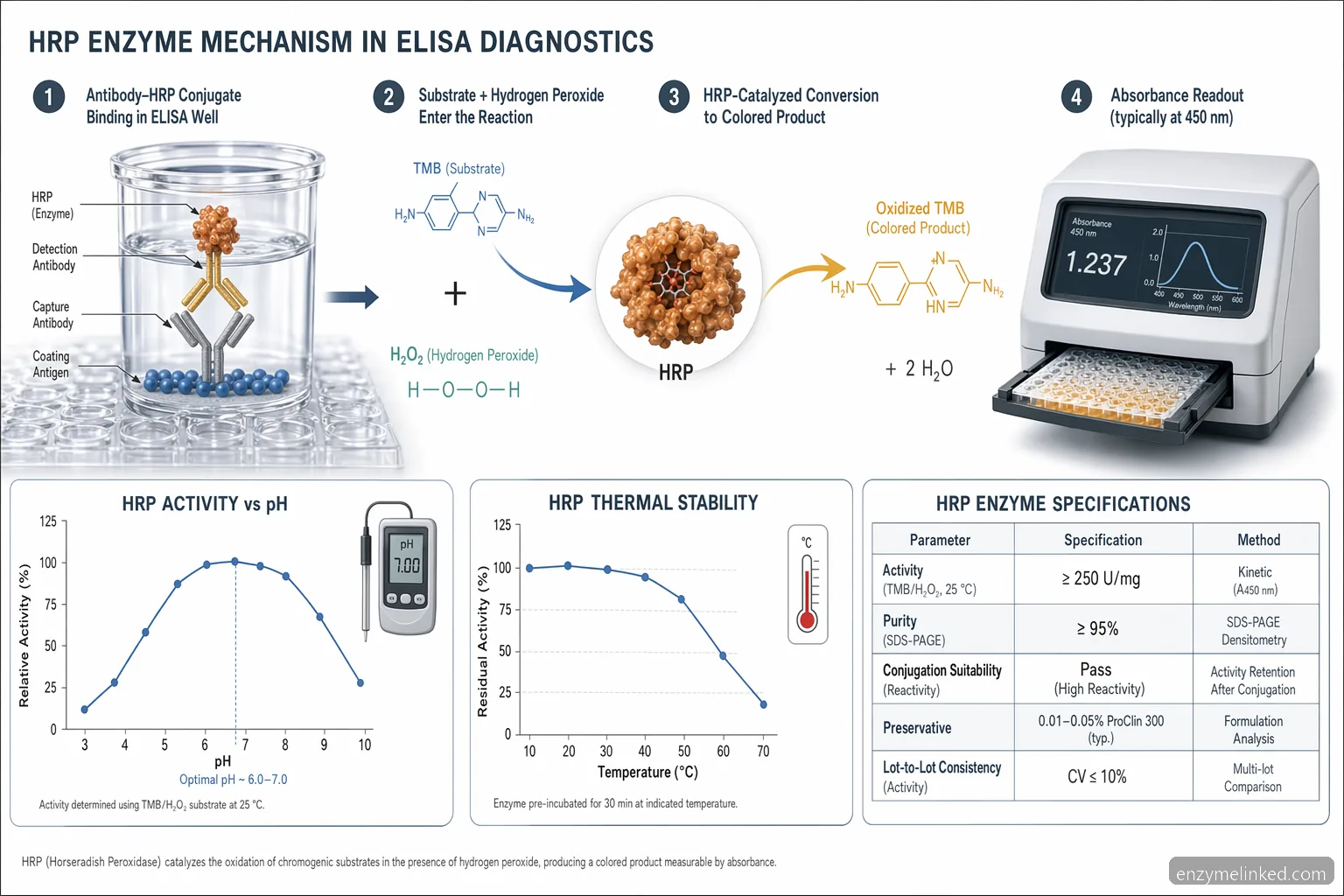
For ELISA and immunoassay manufacturing, HRP enzyme for diagnostics is usually selected because it delivers rapid colorimetric or chemiluminescent signal generation at moderate assay conditions. However, the best choice depends on the full diagnostic workflow: conjugation chemistry, substrate, sample matrix, incubation time, plate reader range, and stability target. A diagnostic grade enzyme should be compared using the same antibody, antigen, blocker, substrate, wash buffer, and acceptance criteria intended for production. Activity units from different methods are not automatically equivalent, so buyers should ask how the supplier defines activity and which substrate, pH, temperature, and calculation method are used. In general enzyme diagnostics, performance is measured by signal-to-background ratio, linearity, limit of detection, inter-lot consistency, and shelf-life behavior after formulation.
Typical HRP working pH: about 6.0-8.0 for conjugate handling. • Common TMB substrate pH: about 5.0-5.5. • Typical assay incubation: 20-37 C, validated by kit design. • Screen conjugate dilutions such as 1:1,000 to 1:20,000 during optimization.
HRP vs Alkaline Phosphatase Diagnostic Enzymes
HRP and alkaline phosphatase diagnostic enzymes are both widely used in ELISA enzymes, but they fit different design priorities. HRP often supports shorter reaction times and broad substrate options, while alkaline phosphatase can be preferred where longer signal development or certain phosphate-based substrates are required. HRP systems often use TMB, ABTS, OPD, or chemiluminescent substrates; alkaline phosphatase systems commonly use pNPP or chemiluminescent dioxetane substrates. The comparison should include endogenous interference risk, stopping solution compatibility, temperature tolerance, background drift, and reader wavelength. For industrial HRP enzyme diagnostics, the practical question is not which enzyme is universally better, but which creates the strongest validated result at the lowest total cost-in-use for the target assay.
HRP substrate systems are commonly run near acidic substrate pH. • Alkaline phosphatase systems often operate near pH 8.5-10.5. • Compare time-to-signal and background after the planned stop time. • Include reagent stability and shipping temperature in cost models.
Specification Checklist for Diagnostic Grade Enzyme Buyers
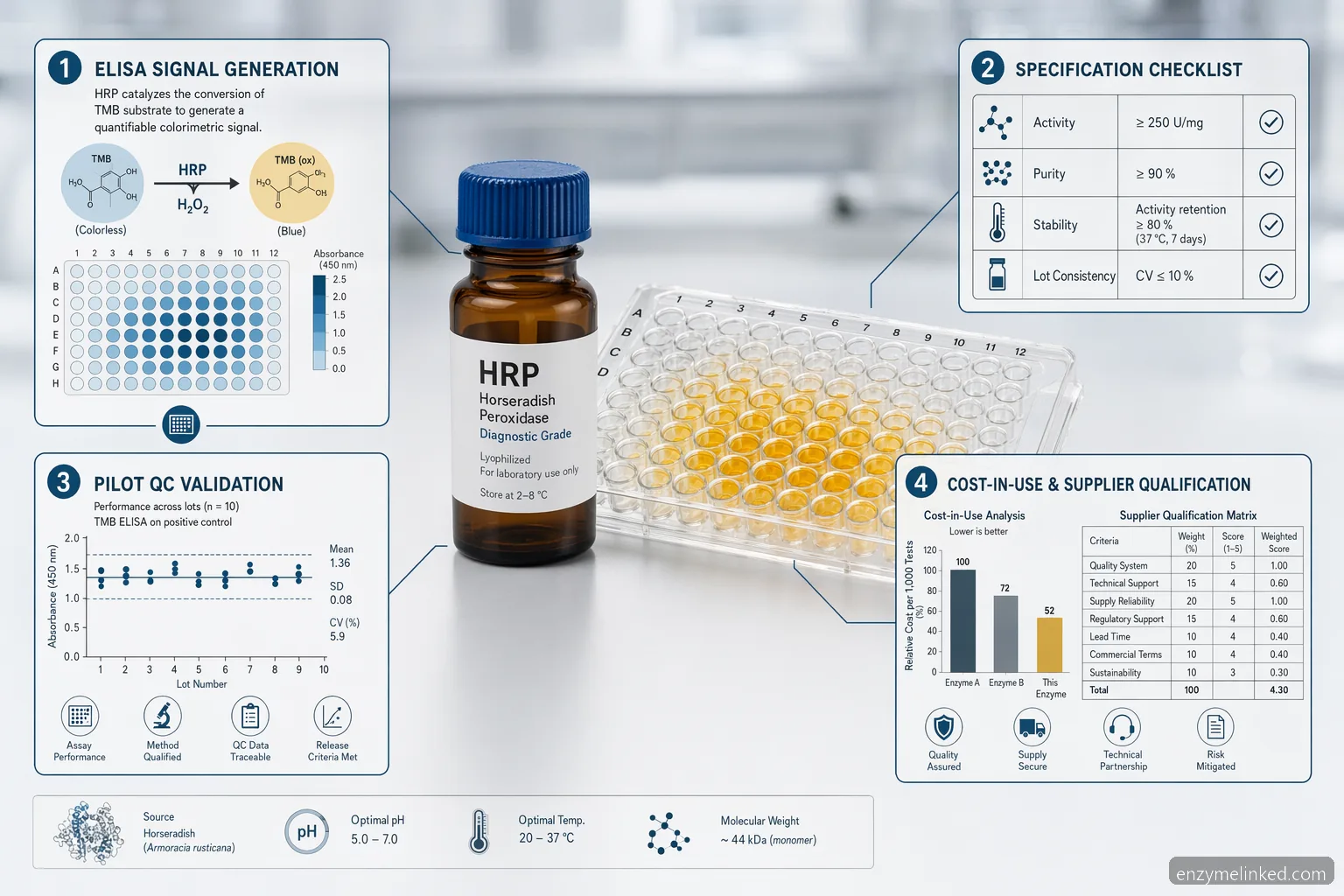
A useful specification for a diagnostic grade enzyme should go beyond catalog activity. Buyers should define enzyme source, purification approach, activity method, purity profile, stabilizers, preservative system, buffer composition, and storage requirements. The COA should report lot-specific activity, protein concentration or activity concentration, appearance, pH, conductivity if relevant, microbial limits where applicable, and test methods. The TDS should explain recommended handling, dilution, compatibility, storage temperature, freeze-thaw precautions, and expected stability format. The SDS should be reviewed for preservatives, hazard classification, and transport considerations. For diagnostics manufacturing, supplier qualification should also include lot-retention policy, change notification process, traceability, batch size capability, and evidence that production controls are suitable for reagent manufacturing.
Request COA, TDS, SDS, and lot traceability before pilot purchase. • Check purity by SDS-PAGE, HPLC, or supplier-supported equivalent methods. • Confirm whether stabilizers affect conjugation or assay background. • Define acceptable activity and signal ranges in your own assay.
Pilot Validation and QC Tests Before Scale-Up
Pilot validation converts a promising HRP enzyme supplier for diagnostics into an approved production source. Run at least three pilot lots where possible, including one aged or stressed lot if available. Test conjugation yield, unbound enzyme removal, conjugate stability, assay signal, blank background, precision, linearity, and matrix effects. Include accelerated and real-time stability at intended storage conditions, commonly 2-8 C for liquid conjugates and colder conditions for some bulk enzyme formats. Freeze-thaw studies are important if warehouse or production handling may expose material to repeated cycles. QC should include activity recovery after formulation, absorbance profile, microbial monitoring where relevant, and side-by-side comparison with the current qualified material. A successful pilot should define release limits, not just pass a one-time feasibility test.
Run low, mid, and high analyte controls in the final assay format. • Use acceptance criteria for CV, blank OD, and dose-response slope. • Evaluate 2-8 C, room-temperature excursion, and freeze-thaw stress. • Document deviations and supplier responses during the pilot phase.
Cost-in-Use and Supplier Qualification
The lowest unit price for HRP enzyme for diagnostics is not always the lowest-cost option. Cost-in-use includes required enzyme loading, conjugation yield, discard rate, retest frequency, stability loss, documentation time, lead time risk, and assay failure cost. A more concentrated or cleaner enzyme may reduce downstream purification burden, improve dilution factor, and lower background even when the purchase price is higher. Supplier qualification should evaluate technical responsiveness, ability to support custom concentration or buffer exchange, change-control discipline, packaging suitability, and continuity of supply. Buyers comparing lipase enzyme assay diagnostics, Tay-Sachs enzyme diagnostics, immunoassay reagents, or enzyme-responsive nanoparticles for drug release and diagnostics should use the same principle: qualify the enzyme against the final analytical function and manufacturing economics.
Model cost per finished plate, strip, or kit, not only cost per gram. • Include rejected batch risk and stability failures in the calculation. • Ask about lead time, minimum order quantity, and reserved capacity. • Use a written supplier scorecard for technical, quality, and supply criteria.
Technical Buying Checklist
Buyer Questions
HRP is suitable when it provides strong signal, low background, compatible conjugation, and stable performance in the final assay format. Buyers should validate it with the actual antibody or antigen, substrate, blocker, wash buffer, incubation temperature, and reader settings. A diagnostic grade enzyme should include lot-specific documentation and reproducible results across pilot lots, not only a high activity value on the supplier COA.
Compare them under the intended assay conditions, including substrate, pH, development time, stopping chemistry, sensitivity target, and stability requirement. HRP often supports faster signal development with common ELISA substrates, while alkaline phosphatase may fit designs that need alkaline substrate systems or longer signal windows. The final decision should be based on validated signal-to-background, precision, shelf life, and cost per finished test.
A qualified HRP enzyme supplier for diagnostics should provide a COA, TDS, SDS, lot traceability, activity method, storage conditions, and clear retest or expiry information. Buyers should also request impurity or purity data, change-control expectations, and packaging details. These documents support incoming QC, regulatory file preparation, risk assessment, and consistent reagent manufacturing across multiple lots.
Unit price can be misleading because enzymes with similar stated activity may perform differently in conjugation and final ELISA signal. Cost-in-use includes dilution factor, conjugation yield, purification losses, failed QC, stability, shipping, documentation effort, and supply risk. A higher-priced diagnostic grade enzyme can be more economical if it reduces background, improves lot consistency, or lowers the enzyme amount needed per finished kit.
Diagnostic Enzymes (ELISA & Assay Grade) for Research & Industry
Need Diagnostic Enzymes (ELISA & Assay Grade) for your lab or production process?
ISO 9001 certified · Food-grade & research-grade · Ships to 80+ countries
Frequently Asked Questions
What makes HRP enzyme suitable for diagnostic ELISA manufacturing?
HRP is suitable when it provides strong signal, low background, compatible conjugation, and stable performance in the final assay format. Buyers should validate it with the actual antibody or antigen, substrate, blocker, wash buffer, incubation temperature, and reader settings. A diagnostic grade enzyme should include lot-specific documentation and reproducible results across pilot lots, not only a high activity value on the supplier COA.
How should buyers compare HRP with alkaline phosphatase diagnostic enzymes?
Compare them under the intended assay conditions, including substrate, pH, development time, stopping chemistry, sensitivity target, and stability requirement. HRP often supports faster signal development with common ELISA substrates, while alkaline phosphatase may fit designs that need alkaline substrate systems or longer signal windows. The final decision should be based on validated signal-to-background, precision, shelf life, and cost per finished test.
Which documents should an HRP enzyme supplier provide?
A qualified HRP enzyme supplier for diagnostics should provide a COA, TDS, SDS, lot traceability, activity method, storage conditions, and clear retest or expiry information. Buyers should also request impurity or purity data, change-control expectations, and packaging details. These documents support incoming QC, regulatory file preparation, risk assessment, and consistent reagent manufacturing across multiple lots.
Why is cost-in-use more important than enzyme unit price?
Unit price can be misleading because enzymes with similar stated activity may perform differently in conjugation and final ELISA signal. Cost-in-use includes dilution factor, conjugation yield, purification losses, failed QC, stability, shipping, documentation effort, and supply risk. A higher-priced diagnostic grade enzyme can be more economical if it reduces background, improves lot consistency, or lowers the enzyme amount needed per finished kit.
Related: Diagnostic Enzymes for Reliable Assay Performance
Turn This Guide Into a Supplier Brief Request a diagnostic enzyme specification review and pilot validation plan for your ELISA workflow. See our application page for Diagnostic Enzymes for Reliable Assay Performance at /applications/diagnostics-importance/ for specs, MOQ, and a free 50 g sample.
Contact Us to Contribute